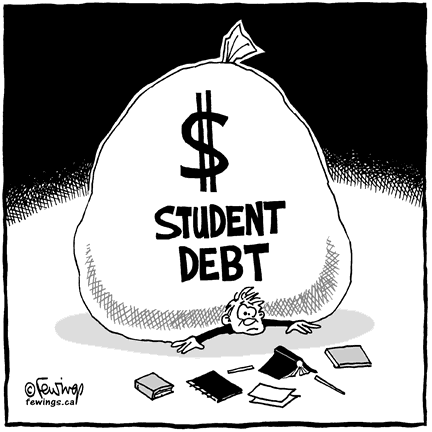
Showing posts with label financial aid. Show all posts

Tuesday, February 14, 2017

Financial Samurai Repost - No Excuses

Hello readers,

Below, I have reposted an article from one of my favorite personal finance blogs, The Financial Samurai. In this article, the author Sam Dogen describes how even janitors in San Francisco can make six figures a year. It's all about working hard! Enjoy.

"Abolish Welfare Mentality: Janitor Makes $271,000, Why Can’t You Too? - Full article here


Let me paraphrase an insightful passage I read that describes the difference between someone with a welfare mentality versus someone with an abundance mentality.
A guy looked at a Corvette the
other day and said to me in a disapproving tone, “I wonder how many people could have been fed for the cost of that car?”
I replied, “I’m not sure. It fed a lot of families in Kentucky who built it. It fed the people who made the tires. It fed the people who made the components. It fed the people who mined the copper. It fed the people who made the trucks that hauled the copper ore. It fed someone who helped sell the car.”
That’s the difference between having an abundance mentality and a welfare mentality. When you buy something, you put money in people’s pockets and give them dignity for their skills.
If you don’t know by now, many people make or have A LOT more than you think. When you see people playing tennis in the park or lounging around at a cafe on a weekday afternoon, it’s unlikely because they are unemployed. It’s because they either don’t need to work or have flexible business hours.
Every week I hear a new story about a person who makes or has way more than you’d ever expect. I’ve shared some of these stories with you.
Uber drivers who make more than their Uber corporate counterparts.
* A ~22 year old female art student from China who bought a $2.25M home for cash.
* The 26-year-old non-techie who landed a $250,000 pay package at Airbnb.
* 100,000+ millennials who expect a ~$1.1M inheritance.
* A University of New Hampshire librarian who left $4M to his school.
* A food blogger who makes $500,000+ a year.
* A Hawaiian entrepreneur who started a greasy spoon franchise and was selling his $8M house that only another entrepreneur could afford.
The point of these posts is to highlight what’s financially possible. Going to a good school to get a job in a traditionally lucrative field isn’t the only way to make good money. Just because you couldn’t get into the greatest school on Earth, The College of William & Mary, doesn’t mean your life is over.

Too many people tell themselves they don’t have the knowledge, skills, connections, background, or pedigree to get rich. Some even stunt their growth because they believe their race, gender, or sexual orientation puts them at a disadvantage.

What a shame to think this way when we have a half black president, plenty of first generation immigrant multi-millionaires, a gay CEO at Apple, a Chinese mayor of San Francisco, and J-Lo! Heck, we even have a man who said a bunch of offensive things and still got elected as the 45th president of the United States. Anything is possible folks!

Six Figure Janitor Cleaning Up

Let’s say you still don’t believe you can be rich despite all my examples. How about this example of a Bay Area Rapid Transit janitor who made $235,000 in 2015 thanks to $165,000 in over time pay!
To be a janitor, you don’t need to go to college or vocational school. You don’t need to be a certain race or sex either. All you’ve got to do is be willing to clean unsightly things. In other words, practically everybody can be a janitor, unless you’re too proud.

What’s great about this story is that Mr. Zhang didn’t just accept his $58,750 base pay. He decided to take advantage of the BART overtime system and work harder. San Francisco has a monster $9.5 billion annual budget. We also passed an enormous $3.5 billion new proposition to improve the system. Why not get your honey money too? Mr. Zhang actually grossed $271,243.02 in 2015 if you include his benefits. Over the last three years, Mr. Zhang received a combined $682,000 in pay and benefits over the last three years, averaging $227,000 a year.
“Almost every day of the year Mr. Zhang is cleaning our stations,” BART spokeswoman Alicia Trost said. “He is signing up for time that is also available to others — if he doesn’t take them, someone else will. Station cleanliness is a priority for us.”
Did you get that folks? Mr. Zhang wasn’t a “privileged janitor” who got allocated more time than others. All he decided to do was out work his colleagues. Unlike some people who found Mr. Zhang’s compensation outrageous, I say well done sir!
For those of you with similar or more “advantageous” backgrounds, there’s no reason why you can’t make as much as Mr. Zhang if you really want to. If you disagree, tell me why in the comments section.

Traits To Adopt To Be Rich

If you want to be rich, adopt these traits.
Work ethic. 40 hours a week is an arbitrary amount of time to work. There are 168 hours in a week. If you worked just five hours more a week, think about how much more you could make or do with an extra 260 hours a year. Mr. Zhang decided to work almost every day of the week for years! You might not have the same chance, but at least you can work on your side business during the weekends.

Desire. You’ve got to really desire to be free. If you’ve got a cushy job that pays you just enough not to leave, then you’re probably just going to stay put and surf Financial Samurai most of your working hours. Remove the complacency IV from your vein.
Risk taker. Put yourself out there. Rejection is just the name of the game when you are constantly taking risks. But if you’re never failing, then you aren’t trying hard enough. It takes effort to find optimal levels of happiness.
Open mind. Think about the many different ways there are to cook fish around the world. There are even more ways to make money and live a lifestyle you want. Read, watch, learn and participate to open your mind.
Humility. Don’t be so arrogant and presume that your way is the only way. Be humble enough to realize when you’re wrong. And when things start to click, be humble enough to remember when things went wrong. Things can change instantly.
Leverage. “Give me a lever long enough and a fulcrum on which to place it, and I shall move the world,” wrote Archimedes. An individual can only put in about 70 hours a week of before they start breaking down. Instead, leverage technology to reach more people. A website’s quality remains constant 24/7.
Organizational discipline. Think about all those people who’ve made a ton and now wonder where it all went. Once you’ve got a solid handle on your money, you can invest your money in the most optimal ways possible. Tracking your finances through a free financial app is a no brainer.

Believe In Yourself

Thinking about creative ways to earn more is hard. It’s why so few people offered their ideas when requested in “Get Rich By Predicting The Future.” But I promise you that it becomes easier building wealth the more you practice.
Take a look at this priceless piece of artwork below. It’s called “Into The Night” by an artist that’s been featured in many major media publications. Notice the intricate battle between light and dark. It’s a metaphor of our daily struggles where we’re constantly trying to overcome our laziness and fears. If you let your eyes relax, you can see darkness winning the battle.
The painting is exquisite and would sell for over $100 million if Jackson Pollock created it.

Alas, I created this painting when I was 26 on my now rental condo balcony. I used some leftover blue, white and black paint to get creative while waiting for the rooms to dry. Then I created a yellow and black version. Then I created another, and another, and another until I ran out of paint. Then I cut off my ear like Van Gogh! Just kidding.

Yes, my art might look like chicken scratch to you. But to me, they are beautiful because I never thought I’d be able to create any type of art at all until I tried. If I had kept practicing my art every week for 13 years, I’m sure I would have a portfolio of amazing work. No wonder why schools try to expose kids to everything just in case something sticks.
Although I gave up art as a young lad, I didn’t give up my creative writing because I believed in myself. Every week someone who doesn’t write for a living tells me my writing sucks. If it’s not my writing they’re criticizing, it’s my website design. If it’s not my website design, it’s my intelligence. The body blows keep coming and I keep advancing. Thank goodness because being able to do something this fun in early retirement is truly a blessing.
If you find yourself chalking up someone’s entire good fortune to luck or if you catch yourself criticizing another for their efforts, slap yourself in the face. Your welfare mentality is keeping you down. Mr. Zhang is out there hustling. So can you."

Tuesday, December 18, 2012

How to Make Money Over Winter Break


If you’re anything like me, you wait all semester to catch a break. But after a few days at home, you somehow find yourself bored out of your mind. You have no projects to think about, no tests to study for, and more time on your hands than you thought you could handle. So what better time to fill your days with a job and make some extra cash? Here are 15 ways to get going on filling up your bank account before spring semester rolls around:

shoveling snow pathway cold weather winter wintertime 1. Shovel some snow- If there’s lots of snow where you live, you might as well make the most of it and offer your shoveling services to your neighbors and family members. Tom Vecchione, executive director of career services at Elon University, calls this money-maker an “oldie but goodie.” He also says he would definitely pay someone to do it for him!
2. Be a distributor- Vecchione says, “Many employers in larger to mid-size areas employ high school and college students to hand out flyers or other marketing items to the public.”  Look around at local coffee shops or ice cream shops to see what flyers are already posted, and then give them a call to see if they’d like any more help.
finger painting hand painting kindergarten children activity fun3. Babysit- Parents are super busy with holiday parties and office parties over break. Offer to watch your cousins, neighbors, siblings or nieces and nephews. You’ll have fun and make good money in the process.  If your neighborhood or high school has an email list-serv, send something out letting everyone know you’re available to help.
4. Watch someone’s pets- Lots of people take short vacations and trips over the holidays. And most people would rather leave their pets at home than kennel them, so offer to feed and walk your neighbor’s dog or feed their fish. You’ll be a great help!  This is another item you can shoot over a neighborhood email list-serv. 
closet messy unorganized piles of clothing5. Clean out your closet- Go through all of your clothes and sell what you don’t want at a local consignment store. Just try not to buy anything there while you’re selling your stuff if the goal is to be cash flow positive!
6. Sell some stuff on the Internet- Use eBay to sell items that you no longer have any use for. It’s an easy way to make money. 
7. Hold onto that summer job- Keep in touch with your boss from this summer. Chances are, he might want to hire you back for a few weeks because he won’t have to train you! Reach out to your boss as soon as you get home and ask him right away if the company will need any help over the holidays.
8. Get into retail- Vecchione says, “Retail, or anything related to helping a company adequately is a great way to spend your break [because] the holidays increase their demand for services.” You can help! When you’re out doing Christmas shopping, spend some time going in and out of stores asking if they’re hiring for the holidays.  
yard garage sale sell old items fundraiser9. Host a garage sale- Ross Wade, Assistant Director of Career Services at Elon University, suggests having a holiday garage sale. Sell all of your old CD’s, DVD’s, handbags, clothes, whatever! Get your siblings or neighbors to organize it with you so you have more to sell and you can all benefit from it! Put up a flyer at your local Community Center or put flyers in mailboxes around your neighborhood to publicize. Post something about it on your Facebook too—you can even make a Facebook photo album that is a sort of gallery of the items you’ll be selling. 
10. Play the ‘nice’ card- Wade suggests playing the nice card. “Be extra nice to your family so they give you some extra money in your holiday card.” Worth a try, right? 
ten dollar bill in the leaves soil
11. Clean the house… in search of money- Do a quick sweep all over your house, taking extra time to look under the couch and behind the cushions. Then take the loose change you’ve gathered up and put it in the Coinstar at your local grocery store. You can convert the change into gift cards, too.  Hey—you said you had a lot of free time, right? 
bookbyte.com textbooks old re-used
12. Sell your old textbooks- Lots of people sell their books back to the bookstore, but you can get a lot more money by selling them to friends or other students who are taking the same classes. Visit websites like bookbyte.com 
upload a design artistic tribal ethnic print
13. Use your artistic ability- Wade says, “If you’re artsy, design and create some holiday cards or art to sell on etsy.com and upload a design for a greeting card. You can sell your personal designs online! 
recycle go green environmentalism
14. Recycle- Did you know that you can get money for recycling? Some grocery stores give customers change in exchange for used plastic bottles. Getting paid to go green? Doesn’t get any better than that! 
15. Wrap it up- Put flyers out in the mailboxes in your neighborhood offering your wrapping services. Say that you’ll take some stress off of their plate by offering to do their present wrapping!

Saturday, November 24, 2012

How to Conquer your Student Loans


Don't despair. You have options with private lenders and the feds to cut your payments.
[Click here to check current credit card offers, including rates and terms.] When Angela Moore looks into her future, she sees checks for $500, $147, $280 and $250 piling up like leaves in a forest. Those are the amounts she could be paying every single month on her four student loans, which total $92,000, for the next several decades. If she postpones payments, the amounts she owes will go up. If she skips them, she could ruin her credit and end up in court.
Moore, 26, graduated with a bachelor's degree from the University of Hartford in 2009 with $25,000 in federal student loans and $67,000 in private loans. She devotes about half of her paycheck to those bills and resorts to credit cards to cover other expenses. Says Moore, the first in her family to graduate from college, "It's heartbreaking to have a college degree and not be able to pay for normal things because I have to pay student loans."
Moore works at an orthopedic surgeon's office, the same job she had in college. She would like to move on someday but can't afford to make less than her current wage of about $18 an hour. Nor does she see an obvious way out of her predicament. "If you're in that much debt and have a house or car, you at least have something you can give back. I have a piece of paper. I have nothing to give back."
Meet the young and burdened. Of borrowers who graduated from four-year colleges in 2008, 10% walked away with $40,000 or more in student debt, almost three times the number of students who borrowed at that level in 2000, according to the Project on Student Debt, an advocacy group. The default rate for students who entered repayment between fiscal year 2006 and fiscal year 2007 was 6.7%, the highest since 1998.
You'd think bankruptcy would be a solution to massive student debt, but for most people, it is not an option. You must demonstrate to a judge that repayment would cause "undue hardship," a term interpreted by some courts to mean the "certainty of hopelessness," according to Deanne Loonin, of the National Consumer Law Center. This strict standard applies to both federal and private student loans. Proposed legislation in Congress would change that standard for private student loans, making them eligible for discharge under the more lenient rules that apply to credit-card and other consumer debt.
Meanwhile, federal loans offer programs that let you reduce payments or even qualify for loan forgiveness. As for private loans, some lenders are offering deals to borrowers rather than see loans go south.
Cut a Deal With a Lender
A few years ago, lenders were rushing to offer private loans to students, including those who were less than creditworthy. Now, borrowers who couldn't afford the loans in the first place are defaulting in droves, says Joshua Cohen, a Hartford-based lawyer who specializes in debt. "The industry is either going to take a bath or start coming after people."
Some lenders hope to avoid both scenarios by offering interest-only repayments or other arrangements that lower payments for a time. "It does us no good to have a customer with a loan he or she is unable to repay," says Patricia Christel, of Sallie Mae, the giant student-loan company. Check your promissory note to see whether it includes such provisions. "It's very case-by-case," says Loonin. If it does not, try to negotiate a plan with your lender.
If you don't reach an agreement, ask the lender for forbearance, in which you make no payments at all for three-month increments, usually for no more than a year (interest continues to accrue). Lenders are less willing than they once were to sign off on these deals, but they may do so if they believe the break will get you back on track. "The important message is, contact your lender sooner rather than later," says Tim Ranzetta, of Student Lending Analytics.
With federal loans, you can be past due for months before going into default. With private loans, you generally fall into that category as soon as you miss one payment. A collector will start calling, and eventually a third-party collection agency will take over the loan. (The Fair Debt Collection Practices Act protects you from abusive collection practices.
Unlike the feds, who have the authority to tap your resources, private creditors must go to court to collect debts. "Until then, there's nothing they can do," says Cohen. Defaults are subject to your state's statute of limitations, typically six years. If you do get sued and lose, the creditor can garnish your wages, put a lien on your house and wipe out your bank account.
Pick a Plan From Uncle Sam
Federal loans, which include Perkins loans, Stafford loans and Grad Plus loans, provide more options. (The Perkins loan repayment provisions differ somewhat from the other two; call your school for details.) For Staffords and Grad Plus loans, the standard plan gets you out from under after 120 equal monthly payments over ten years. If you can't afford those payments but expect to have a higher income in a few years, you can choose the graduated plan, through which you make lower payments in the first few years and higher payments later over the ten-year span. Because you pay less at the beginning, you pay more interest overall.
If you owe at least $30,000 in federal loans, consider the extended repayment plan, which lets you stretch monthly payments as far out as 25 years, for lower monthly amounts but at a higher cost. Or you can consolidate your federal loans through the federal Direct Loan program and extend your payments to 12 to 30 years, depending on the amount you owe. (For details, seewww.loanconsolidation.ed.gov.)
Borrowers whose federal debt outstrips their annual income should look into the income-based repayment plan, which is "like gold" for those who qualify, says Edie Irons, of the Project on Student Debt. This program, which improves on two other income-based programs, can reduce your payments to as low as zero.
You probably qualify if your total debt exceeds your annual income. After 25 years, any remaining debt is forgiven; you owe tax on the forgiven amount. If you enter the income-based repayment plan and then get a big bump in salary, your payments from that point on are calculated according to the standard plan.
Cops, public defenders, public-school teachers and others working full-time in the public sector qualify for cancellation of any remaining debt after 120 payments, made on or after October 1, 2007. To get this deal, your loans must be with the federal Direct Loan program, as opposed to the now-defunct program (known as FFEL) offered by private lenders. You can consolidate FFEL loans into the Direct Loan program. The forgiven amount is tax-free.
You have the right to defer federal-loan repayments for up to three years if you are unemployed, experiencing economic hardship, attending school at least half-time or serving on active duty in the military. The feds pick up the interest during the deferment on subsidized loans but not on unsubsidized loans. Call your lender for details.
If deferment isn't an option, ask your lender for forbearance. With a federal loan, you can suspend payments for up to three 12-month periods. Depending on the amount you earn and owe, you may be legally entitled to this deal. If not, ask anyway: It's in the lender's best interest to give you time to get on your feet. Interest accrues during forbearance.

Thursday, October 4, 2012

5 Ways to Fund a College Education


According to CNNMoney, the average tuition cost at the average public university rose over 8% in 2011. The following tips are designed to dissuade you from skipping college because you think you can't afford it, and to show you some strategies for making higher education expenses fit into your budget.

Choose Your School Go to an in-state public school or a public school in a surrounding state that has reciprocity for reduced tuition, which will be much lower than rates at a non-reciprocal out-of-state public school or a private school. If you are not satisfied with the quality of the state schools where you live, consider moving to a state with schools you like and establishing residency.
To establish residency, you will have to meet strict requirements that vary by state and sometimes even by school - but for the savings, it may be worth it. Most states require you to live in the state for at least one year in order to be eligible, but there are other criteria to meet as well. In California, for example, it is very difficult for students who don't have a parent living in California to establish residency before their mid-20s. In addition to living in-state for 366 days immediately prior to requesting resident status, potential students must provide objective documentation demonstrating an intent to make California their permanent state of residence, such as a driver's license, ownership of property or steady employment, as well as financial independence.
If you can wait it out and meet these criteria, then you can attend quality schools at in-state rates.
Another money-saving strategy that doesn't involve postponing college is to apply to schools that have a shortage of people like you. People like you could be people interested in your major, people from your state, people with your ethnic background, people who are as smart as or smarter than others applying to the school, people who play the unusual instrument you play or any other number of traits. Schools where you'd be a unique addition may give you scholarships.

Think About Cost of Living Keep in mind that housing and other living costs will vary by location, especially if you choose to live off campus. An apartment in New York City will be much pricier than an apartment in the Midwest. Also, the college where you obtain your undergraduate degree can sometimes influence where you will end up working and living after school. If possible, choose a location where you'd actually want to live, where the cost of living is affordable, and where your school will be a recognizable name that will allow you to get more mileage from your diploma. UCLA may be considered a good school in the West, but may not be held in the same high regard in New York.

Don't Get Just Any Job to Pay for School Make your job count by sticking to high-paying work. To find high-paying work, especially for summer jobs when you'll be free during business hours, seek out office jobs through temp agencies. Temp agencies do most of the job hunting work for you, and the office jobs they offer tend to pay above minimum wage, provide work experience closer to the situations you'll encounter post-college, and may give you connections that will help you land a meaningful internship or your first salaried position. Also, despite what the name implies, you can find both short and long-term jobs through temp agencies.
If you can't get a high-paying job, get a job that will keep your living expenses down, such as working in a restaurant where you get free food. If you work at a bakery, for example, any unsold goods at the end of the day may be fair game for employees since the business can't sell day-old bread. Another possibility is to find a campus job that offers perks. If you can get a job in your school's residential life office, you may be able to get a discount on housing during the school year or the summer.
If you're still in high school, start working now and save all your paychecks for college. You're still living at home; you probably don't have high living expenses chomping into your earnings like you will later on. Also, see if your high school has a program that will allow you to leave school at noon every day to go to work during your senior year. This will increase your job options, including opening up the possibility of the aforementioned office job, and allow you to work more hours.

Be Flexible with Your Schedule Some college programs, such as engineering, are more intense than others, making it quite difficult to work while in school. For these programs, consider attending school part-time so you can still work part-time. Even if you're not in an overly demanding program, attending school part-time can help you spread out tuition costs and free up more time to work. However, part-time students may not have the option of living on campus, which can make it more difficult to be involved in the social aspects of college.

Wait Another option is to take a year or two off after high school to work full-time so you can save up enough money to make school affordable. If you don't want to postpone college, you could take your classes during evenings and weekends in order to work full-time during the week. This strategy may take more than four years to complete, but it can be easier to budget. One argument against this approach is that many people find it easier psychologically to go straight from high school to college because study habits are still ingrained.
With education costs as high as they are and certain financial situations that fall outside the norm, even some middle-class parents may not be able to make significant contributions to a child's higher education costs despite what the formulas insist.
If you have a lot of patience, you can wait until you become an independent student as defined by the Higher Education Act, which has a different definition of "dependent" than the Internal Revenue Service (IRS). If you identify with some of the following you may qualify as an independent student.

    • 24 years or older by December 31 of the award year

    • Orphan or ward of the court

    • Armed Forces Veteran or serving actively

    • Graduate or professional student

    • Married

    • Dependents other than a spouse

    • Student for whom a financial aid administrator makes a documented determination of independence by reason of other unusual circumstances
Being an "independent student" under the Higher Education Act could make you be eligible for more financial aid because the financial aid formulas applied to this group won't take parental contributions into account.

The Bottom Line Some of these measures are purely practical and don't take into account many of the intangibles of the college experience, such as the learning experience of freshman dorm life. Before you start on your college plan, consider everything you want to get out of college so that you don't have regrets later. Although you may have to make some sacrifices that your peers don't, such as starting school later or staying in the state, you can still have the experience you want and attain a degree that will lead to a financially successful and stable future.

Original Post: http://finance.yahoo.com/news/5-ways-fund-college-education-204748990.html;_ylt=AuTzh2NnbN7krCyQ_MYkoZvz6IdG;_ylu=X3oDMTNoMWI3c3FkBG1pdANGaW5hbmNlIEluZmluaXRlIEJyb3dzZSBTcGxpdARwa2cDNDg5OTZiMjktZDNiNi0zMGJjLWFhNWItNGU5ZDE3MDdhM2QzBHBvcwNsMgRzZWMDbWVkaWFpbmZpbml0ZWJyb3dzZWxpc3R0ZW1w;_ylg=X3oDMTNqNDVub244BGludGwDdXMEbGFuZwNlbi11cwRwc3RhaWQDM2M4MmMyMjktMmI4OC0zYTRkLTgwM2QtMTQ0ZDQ2MWUwYmFjBHBzdGNhdANwZXJzb25hbGZpbmFuY2V8Y2FyZWVyLWVkdWNhdGlvbgRwdANzdG9yeXBhZ2U-;_ylv=3

Wednesday, September 19, 2012

11 Ways to Save Big on College Textbooks


Most college students will be returning to campus later this month, and they’ll spend an estimated average of $655 on textbooks for the school year.
That sounds low to me – more like what I’d spend in a semester as an English major a few years ago.
The National Association of College Stores says today’s prices are less than two years ago ($667) or four years ago ($702), but it’s still a lot. And $47 in savings isn’t all that comforting when you consider the average total cost of college has jumped 28.6 percent – almost $4,000 – over those same four years, according to the U.S. Department of Education.
Anything you can do to offset costs counts. So here are some strategies to save on your textbooks. Also, check out how to make the most from selling your books.
Now let’s add more details and tips…

1. Contact your professors now

Class may not start for weeks, but chances are your textbooks are already decided – professors have to give college stores advance notice so they can order copies. So email your profs and ask for the syllabus or required textbook list so you can snag the cheapest copies before your classmates get the chance.
If you know students who have had that professor before, talk to them. They might still have a copy for cheap. And the professor might say you need a certain book, but your friend who had him might tell you they only used it in class once, and there was nothing from it on the tests. But either way, before you buy…

2. Visit the campus library

Why pay anything when you can borrow it free? If you’re quick enough, you may be able to get one of the library’s precious few copies. If it’s checked out, see if you can reserve a copy that’s due back soon.
And don’t forget digital libraries. As Stacy mentioned in the video, many out-of-copyright works are available on sites such as Project Gutenberg and Bartleby.

3. Buy used

Used books have to be in decent condition for stores to resell them, so that’s not a concern. The savings can be significant, especially on an older edition. On several occasions in college, I bought used books online for less than $10 (including shipping) when the new price was $60 or more. None had significant defects (sometimes a little highlighting or writing) or were missing anything essential for the class.

4. Check rentals

Companies like Chegg, BookRenter and CampusBookRentals helped create an active market for textbook rental. Now many college bookstores offer the option, which can save a third or more over buying. (If you rent from an online store, shipping is usually covered.)
Just be aware that if the book is relevant to your major and you might reuse it, the savings might be greater by buying. It can be hard to tell whether you’ll need a book again, but if it’s by an author important to the field, the odds increase you’ll want to own. I had books overlap in different English classes, and I also reused a few books from undergrad in my graduate courses.

5. Look for digital

As the number of tablets and e-readers grows, so does the selection of digital textbooks. And you can also rent digitally. Last year, The Chronicle of Higher Education found an accounting textbook that “retails at $197 in print and $109 as an e-book, [but] would cost $57 to rent from Amazon for three months,” with the option to extend the rental or purchase it later. Amazon suggests you can save up to 80 percent with its Kindle rentals, and you don’t even need to buy a Kindle – there are compatible reading apps for computers and smartphones.

6. Compare prices

Prices can vary widely among both new and used copies, and online isn’t always cheaper. You can easily save 20 percent even on new books by comparison shopping.
At a minimum, I would suggest checking at Half.com and Amazon.com in addition to your school bookstore and any nearby off-campus competitors.
BookFinder.com, DirectTextbook.com, and TextbookPriceComparison.com can help you compare.

7. Make sure you get everything

Sometimes books are packaged with software, codes for required online access, digital content, study guides, or workbooks. If the course requires any of that stuff, make sure your copy includes it – or that you can still save by buying it separately.

8. Know the rules

Understand the refund policy when you buy, so you don’t get burned if you end up not needing a book or drop a class. Being in a hurry to open it can hurt you – unwrapped or marked books might not get you a full refund.

9. Keep receipts

Not only will you need these for returns, but you might want them for tax deductions.

10. Pay smart

Your school may offer textbook advance loans to ease you into the semester before financial aid comes in. You might also be tempted to charge books to your credit card. Both those options risk extra fees and possibly interest, so read up before you swipe or sign.
On the other hand, credit cards are smart to use for online purchases, in case there are any disputes. Just pay off the balance as quickly as possible.

11. Sell back

Digital books and rentals may save you money up front, but until they dominate the market, most textbooks will still have good resale value. For now, you ultimately keep more money in your pocket by buying used and reselling before a new edition is released. (When a new edition comes out, the value plummets – which is why you can buy old editions for so little.) But notice we say “sell,” and not “trade in.” Selling to your college store after finals is fast, but it’s not the way to get the most money back.
If you have the financial flexibility, reselling is the way to save the most. In May, we did an in-depth post on how to turn your textbooks into cash. Here’s a sample of Money Talks News writer Ricky Michalski’s analysis…
I found Chegg sells [my chemistry book] for:
  • $165.49 new
  • $155.49 used
  • $117.99 as an e-book
  • $50.99 for a rental copy
But I bought the same book used on Amazon for $75 – and when I was ready to sell it, one bookstore near my campus offered me $72 for my copy. Final price: $3 for a textbook!
Bottom line? There are tons of ways to save on textbooks, some mutually exclusive. But a little legwork can mean really big savings.

Tuesday, July 24, 2012

5 Ways to Earn and Save Money on College Costs

Graduate with as much cash as possible in your wallet.
Hey readers, check out this quality post from www.thepennyhoarder.com about earning and saving in college.

If I’m lost in thought, odds are I’m thinking about how I can hoard a few extra pennies.
I try and monetize my whole day. I want to make money on my drive to work, while I’m brushing my teeth and even as I shop at the grocery store. I even try and find ways to make money while paying bills – and if there is one bill where there is money to be made, it’s with your college tuition.

Put it on a Rewards Card

Don’t use cash or a check this coming college semester. Instead, make sure you are paying with your rewards card. The average cost for public college tuition is $12,804. By using a credit card with 1% back, you’d earn nearly $130 every semester.
Even if you don’t have the money in your wallet to cover tuition, you can still take advantage of this opportunity. Most federal loan programs will refund tuition fees, even after you’ve paid them.

Pay Through a 529 Plan

529 plans are state-run investment plans that allow you to save money for college. Most states provide a tax advantage for participation by allowing you to deduct contributions from your state income taxes. They are a great way to save for college. However, you can also use them to make money while paying for your college tuition.
If you have money to pay your tuition, but have no 529 plan, it’s not too late to benefit. Simply open the account with your tuition payment and then make a withdrawal to pay tuition. By contributing any amount of money for any length of time – even a day – you should be able to claim the tax benefit and pocket the tax savings.


Rent Those Textbooks

We all know that visiting the college bookstore is a horribly overpriced adventure, so try renting your textbooks this year. Sites like CampusBookRentals.com can save you up to 90% on your textbooks. Plus, you won’t have to go through the hassle of trying to sell your books at the end of each semester. Truthfully, college bookstores seems to buy back fewer and fewer books each semester as many of the textbook companies have begun to churn out new additions on a yearly basis.
Most of these sites also offer free shipping, so there aren’t any fees to send your books back at the end of the semester.

Take a Federal Tax Credit

The American Opportunity tax credit was established in 2008 to help offset some of the high costs of attending college. It provides a reimbursement of up to $2,500 on your tax bill. It is even 40 percent refundable, should you owe no taxes. That translates into a potential to earn $1,000 for paying your tuition bill.
You don’t have to pay your bill out-of-pocket to claim the credit. Utilizing student loans, a 529 or plan or your rewards card will all qualify you to receive the credit.
There are a number of other Federal credits and deductions that may be taken instead of the American Opportunity tax credit. You can directly deduct up to $4,000 in tuition expenses from your taxable income. Also, there is the Lifetime Learning credit which reduces your tax bill by $2,000 to $4,000 so long as tuition is paid.

Use Student Loans and Invest Your College Savings

This option has plenty of risks of potential loss, so please consider cautiously before following this option. Given the low interest cost of government student loans, there is the opportunity to take advantage of interest arbitrage by investing your tuition savings in the stock market.
Government loans are currently set at 3.8 percent and interest is tax deductible, which lowers your interest rate by your tax rate. The stock market traditionally earns far more in capital gains. If you have money to pay your tuition bill, you can make money by putting that money in the stock market and paying your tuition with student loans. If you could earn 7 percent in the stock market and loans cost 3.8 percent, you can earn 3.2 percent in interest by investing, instead of paying your college tuition.
By going to college you stand to earn a much higher starting salary, but there’s no reason why you can’t start earning more money while paying for tuition.

Friday, June 15, 2012

Save Money in a Recession

It's not always about what you make, but more about what you keep. Check out this article from Lifehacker.com with 10 tips on saving money in a lame economy.

Top 10 Ways to Save Money in a Recession

10. Get better at re-using your stuff

Top 10 Ways to Save Money in a RecessionIt's the kind of stuff that fueled your grandparents' stories about hard times: Stretching supposedly disposable, used items further than most consumer companies want you to; Using your mind—and your hands—to solve problems without jumping in the car and busting out the wallet. We suggest finding inspiration from how Lifehacker readers creatively reuse disposable items. Re-purposing isn't all about balled-up tinfoil and grimacing, of course. Our most popular re-purposing posts of 2008 show that a little thought and some creative tinkering usually pays off with a one-of-a-kind solution to household needs.

9. Cut your food costs

Other than shelter (rent) and water (also rent, or municipal bills), food is the one thing you have to spend money on every day. If you really want to hack down your bills, carnivores can save money by buying whole animals—a process that's easier than they might think. For a weekend kick, you can make your favorite chain restaurant recipe at home. Stay away from the high-fat cruft on dollar menus and switch to a cheaper, healthier Mediterranean diet or these twenty health foods for $1 or less. And for those nights when cooking a full, healthy meal just isn't in the cards, a "Microwave Diet" is a surprisingly nutritious fall-back.

8. Dress and look sharp with less cash

Let's not pretend you can look like a million bucks with $7 and change. What you can do is focus on taking a clean, elegant style and maintain and extend it without hitting the malls at all. The thrift-conscious J.D. at theGet Rich Slowly blog has 18 tips on smarter used clothing buys, whether as a staple or just a complement to your wardrobe. And, while the political hook is a bit, er, dated, we did consult with style-conscious types tohelp dress like a honcho with humble means. For everything else that isn't soap and a haircut, try taking on easy ways to look sharp, like de-cheap-ifying a suit, shaving with a straight razor, and using coat hangers to prove to yourself that, yes, you really do have something to wear. Photo bybrooklyn.

7. Start working for yourself (crazy as it sounds)

Even if you've invested in your paid-by-someone-else career, the layoffs just keep happening, leaving hard workers looking for their next gig. Assuming one's money is locked down, it can be surprising how much cheaper it is to start working for yourself—if the conditions are right. The self-employed route is one of the most common suggestions from our readers in response topost-layoff confusion, and if you don't have to pay for a commute, parking, lunch-on-the-go, daycare, or many other costs, freelance work might help you stem the losses, at least until you can land back on your feet. Everyone's situation is different, of course, and self-secured healthcare isn't getting cheaper, but we happen to know at least one certain blogger/developer who's taking a chance on working totally off the grid for 2009.

6. Cut the cable and get your TV free

Top 10 Ways to Save Money in a RecessionWhen the nation-wide transition to all-digital, over-the-air television happens (be it Feb. 17 or later), anyone with an antenna will get digital channels for free (in fact, you may even get more channels than you were before). If you don't get great reception, or you like your television a bit more on-demand, there's never been more free programming on the web. Start with our six ways to catch your favorite TV shows, which covers the free market in all its forms, from official sites to BitTorrent. Next, check out Lifehacker readers' five favorite sites to stream TV for more inspiration. Looking for something that doesn't tie up your computer? Our ooh-shiny-savvy sibling Gizmodo has posted a great tutorial on taking a relatively cheap Apple cast-off, the AppleTV, and using the free Boxee software to spin it into a TV-streaming, download-playing, multi-media powerhouse.

5. Trim your cell phone costs

Top 10 Ways to Save Money in a RecessionThe economy stinks for you, but it reallystinks for providers of services that can easily be scaled back—like cell phone providers. On the one hand, they may fight harder to keep you paying for data plans, text messages, and other "value added" items, but they really, truly don't want to lose you as a customer. If you can't re-negotiate a better deal, though, take a tip from PC Magazine columnist Sascha Segan and cut your phone bill by actually jumping ship (to a pay-as-you-go phone), then let them come crawling back with a package pitch. Stuck in a contract with a huge cancellation fee? Check out contract-swapping sites like CellTradeUSA.com and CellSwapper.com, which make use of (legal!) trade clauses and might just help you escape your monthly vig.

4. Invest in your career

Financial guru Warren Buffett, as he so often does, said it best back in April, before the market fell: Unless you're going to make investment analysis a nearly full-time gig, you're better off spending your discretionary time in furthering your main career and honing your skills than surrounded by earnings reports and endlessly changing charts. It's the same reasoning SmartMoney's Jack Hough uses in explaining why renting might make more sense than buying, especially if you're not partial to putting work, time, and money into a place right now. Neither is a call to yank all your hard investments out and start a blacksmith shop (as appealing as some might find the idea), but they reason that the revenue-generating asset you might have the most control over is your career.

3. Trick yourself into spending less, saving more

Top 10 Ways to Save Money in a RecessionCurbing spending, like cutting back on calories, is something any self-help-ish expert can and will tell you to do, with few details given. So you're left, just as with dieting, to come up with your tricks and techniques for teaching yourself to do and not do certain things. When it comes totricking yourself into saving money, we like the kind that you don't need much to start out doing, like Merlin Mann's Crap I Just Don't Need.txt file, in which he captures all his do-wants and must-haves, as if it were a wish list, but ends up checking it every so often to see just how well he's gotten along without all those things. High-speed, low-drag spending psychology. Photo by Darren Hester.

2. Get serious about Craigslist

Top 10 Ways to Save Money in a RecessionCraigslist is a website built for an economy that's scaling back to basics. People looking for extra cash divest themselves of stuff they don't really need, and those who need to spend less snatch up their stuff. If you're on either side, it helps to have the right tools. Get savvy with your selling by digesting Adam's seller's guide to Craigslist, and on the flip side with our Craigslist tips for power users. Hone down on exactly what you're looking for (time is money, after all) with thepreviously mentioned Craigslist Image Preview extension, or the image mashupMyWiseBunny.com (formerly CLHack.com). It can feel harsh grabbing up deals when you know times are tough, but to many sellers, the buyer who actually pays is worth more than some future ideal of better times.

1. Reduce your bills by simply asking

One of the most effective means of shaving money off your monthly costs doesn't involve a website, coupon code, or any kind of hack, unless you count working up the small courage required to just, well, ask. Our weekend editor Jason found deals on his internet package, gas bills, household insurance, and even trash disposal, just by being persistent and, in most cases, simply asking if there was a deal he didn't know about. Read his tips on reducing by asking, then down the last of your coffee and get on the horn. Photo by WoodleyWonderworks.
Where have you found unexpected savings or earnings in recent months? What's your plan for cutting back or cashing in if the downturn continues? Share your story in the comments.
Times are tough, money's tight, and nobody should be spending more than they need. If you think you've exhausted all avenues for saving a buck, check out our ten suggestions for saving money in a recession.

10. Get better at re-using your stuff

Top 10 Ways to Save Money in a Recession

It's the kind of stuff that fueled your grandparents' stories about hard times: Stretching supposedly disposable, used items further than most consumer companies want you to; Using your mind—and your hands—to solve problems without jumping in the car and busting out the wallet. We suggest finding inspiration from how Lifehacker readers creatively reuse disposable items. Re-purposing isn't all about balled-up tinfoil and grimacing, of course. Our most popular re-purposing posts of 2008 show that a little thought and some creative tinkering usually pays off with a one-of-a-kind solution to household needs.

9. Cut your food costs

Other than shelter (rent) and water (also rent, or municipal bills), food is the one thing you have to spend money on every day. If you really want to hack down your bills, carnivores can save money by buying whole animals—a process that's easier than they might think. For a weekend kick, you can make your favorite chain restaurant recipe at home. Stay away from the high-fat cruft on dollar menus and switch to a cheaper, healthier Mediterranean diet or these twenty health foods for $1 or less. And for those nights when cooking a full, healthy meal just isn't in the cards, a "Microwave Diet" is a surprisingly nutritious fall-back.

8. Dress and look sharp with less cash

Let's not pretend you can look like a million bucks with $7 and change. What you can do is focus on taking a clean, elegant style and maintain and extend it without hitting the malls at all. The thrift-conscious J.D. at theGet Rich Slowly blog has 18 tips on smarter used clothing buys, whether as a staple or just a complement to your wardrobe. And, while the political hook is a bit, er, dated, we did consult with style-conscious types to help dress like a honcho with humble means. For everything else that isn't soap and a haircut, try taking on easy ways to look sharp, like de-cheap-ifying a suit, shaving with a straight razor, and using coat hangers to prove to yourself that, yes, you really do have something to wear. Photo bybrooklyn.

7. Start working for yourself (crazy as it sounds)

Even if you've invested in your paid-by-someone-else career, the layoffs just keep happening, leaving hard workers looking for their next gig. Assuming one's money is locked down, it can be surprising how much cheaper it is to start working for yourself—if the conditions are right. The self-employed route is one of the most common suggestions from our readers in response topost-layoff confusion, and if you don't have to pay for a commute, parking, lunch-on-the-go, daycare, or many other costs, freelance work might help you stem the losses, at least until you can land back on your feet. Everyone's situation is different, of course, and self-secured healthcare isn't getting cheaper, but we happen to know at least one certain blogger/developer who's taking a chance on working totally off the grid for 2009.

6. Cut the cable and get your TV free

Top 10 Ways to Save Money in a RecessionWhen the nation-wide transition to all-digital, over-the-air television happens (be it Feb. 17 or later), anyone with an antenna will get digital channels for free (in fact, you may even get more channels than you were before). If you don't get great reception, or you like your television a bit more on-demand, there's never been more free programming on the web. Start with our six ways to catch your favorite TV shows, which covers the free market in all its forms, from official sites to BitTorrent. Next, check out Lifehacker readers' five favorite sites to stream TV for more inspiration. Looking for something that doesn't tie up your computer? Our ooh-shiny-savvy sibling Gizmodo has posted a great tutorial on taking a relatively cheap Apple cast-off, the AppleTV, and using the free Boxee software to spin it into a TV-streaming, download-playing, multi-media powerhouse.

5. Trim your cell phone costs

Top 10 Ways to Save Money in a RecessionThe economy stinks for you, but it reallystinks for providers of services that can easily be scaled back—like cell phone providers. On the one hand, they may fight harder to keep you paying for data plans, text messages, and other "value added" items, but they really, truly don't want to lose you as a customer. If you can't re-negotiate a better deal, though, take a tip from PC Magazine columnist Sascha Segan and cut your phone bill by actually jumping ship (to a pay-as-you-go phone), then let them come crawling back with a package pitch. Stuck in a contract with a huge cancellation fee? Check out contract-swapping sites like CellTradeUSA.com and CellSwapper.com, which make use of (legal!) trade clauses and might just help you escape your monthly vig.

4. Invest in your career

Financial guru Warren Buffett, as he so often does, said it best back in April, before the market fell: Unless you're going to make investment analysis a nearly full-time gig, you're better off spending your discretionary time in furthering your main career and honing your skills than surrounded by earnings reports and endlessly changing charts. It's the same reasoning SmartMoney's Jack Hough uses in explaining why renting might make more sense than buying, especially if you're not partial to putting work, time, and money into a place right now. Neither is a call to yank all your hard investments out and start a blacksmith shop (as appealing as some might find the idea), but they reason that the revenue-generating asset you might have the most control over is your career.

3. Trick yourself into spending less, saving more

Top 10 Ways to Save Money in a RecessionCurbing spending, like cutting back on calories, is something any self-help-ish expert can and will tell you to do, with few details given. So you're left, just as with dieting, to come up with your tricks and techniques for teaching yourself to do and not do certain things. When it comes totricking yourself into saving money, we like the kind that you don't need much to start out doing, like Merlin Mann's Crap I Just Don't Need.txt file, in which he captures all his do-wants and must-haves, as if it were a wish list, but ends up checking it every so often to see just how well he's gotten along without all those things. High-speed, low-drag spending psychology. Photo by Darren Hester.

2. Get serious about Craigslist

Top 10 Ways to Save Money in a RecessionCraigslist is a website built for an economy that's scaling back to basics. People looking for extra cash divest themselves of stuff they don't really need, and those who need to spend less snatch up their stuff. If you're on either side, it helps to have the right tools. Get savvy with your selling by digesting Adam's seller's guide to Craigslist, and on the flip side with our Craigslist tips for power users. Hone down on exactly what you're looking for (time is money, after all) with thepreviously mentioned Craigslist Image Preview extension, or the image mashupMyWiseBunny.com (formerly CLHack.com). It can feel harsh grabbing up deals when you know times are tough, but to many sellers, the buyer who actually pays is worth more than some future ideal of better times.

1. Reduce your bills by simply asking

One of the most effective means of shaving money off your monthly costs doesn't involve a website, coupon code, or any kind of hack, unless you count working up the small courage required to just, well, ask. Our weekend editor Jason found deals on his internet package, gas bills, household insurance, and even trash disposal, just by being persistent and, in most cases, simply asking if there was a deal he didn't know about. Read his tips on reducing by asking, then down the last of your coffee and get on the horn. Photo by WoodleyWonderworks.
Where have you found unexpected savings or earnings in recent months? What's your plan for cutting back or cashing in if the downturn continues? Share your story in the comments.