Showing posts with label save money. Show all posts

Saturday, November 24, 2012

How to Conquer your Student Loans


Don't despair. You have options with private lenders and the feds to cut your payments.
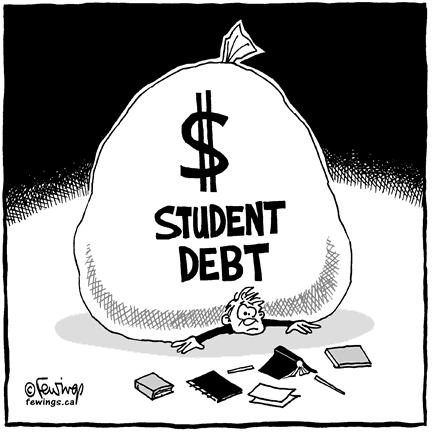
[Click here to check current credit card offers, including rates and terms.] When Angela Moore looks into her future, she sees checks for $500, $147, $280 and $250 piling up like leaves in a forest. Those are the amounts she could be paying every single month on her four student loans, which total $92,000, for the next several decades. If she postpones payments, the amounts she owes will go up. If she skips them, she could ruin her credit and end up in court.
Moore, 26, graduated with a bachelor's degree from the University of Hartford in 2009 with $25,000 in federal student loans and $67,000 in private loans. She devotes about half of her paycheck to those bills and resorts to credit cards to cover other expenses. Says Moore, the first in her family to graduate from college, "It's heartbreaking to have a college degree and not be able to pay for normal things because I have to pay student loans."
Moore works at an orthopedic surgeon's office, the same job she had in college. She would like to move on someday but can't afford to make less than her current wage of about $18 an hour. Nor does she see an obvious way out of her predicament. "If you're in that much debt and have a house or car, you at least have something you can give back. I have a piece of paper. I have nothing to give back."
Meet the young and burdened. Of borrowers who graduated from four-year colleges in 2008, 10% walked away with $40,000 or more in student debt, almost three times the number of students who borrowed at that level in 2000, according to the Project on Student Debt, an advocacy group. The default rate for students who entered repayment between fiscal year 2006 and fiscal year 2007 was 6.7%, the highest since 1998.
You'd think bankruptcy would be a solution to massive student debt, but for most people, it is not an option. You must demonstrate to a judge that repayment would cause "undue hardship," a term interpreted by some courts to mean the "certainty of hopelessness," according to Deanne Loonin, of the National Consumer Law Center. This strict standard applies to both federal and private student loans. Proposed legislation in Congress would change that standard for private student loans, making them eligible for discharge under the more lenient rules that apply to credit-card and other consumer debt.
Meanwhile, federal loans offer programs that let you reduce payments or even qualify for loan forgiveness. As for private loans, some lenders are offering deals to borrowers rather than see loans go south.
Cut a Deal With a Lender
A few years ago, lenders were rushing to offer private loans to students, including those who were less than creditworthy. Now, borrowers who couldn't afford the loans in the first place are defaulting in droves, says Joshua Cohen, a Hartford-based lawyer who specializes in debt. "The industry is either going to take a bath or start coming after people."
Some lenders hope to avoid both scenarios by offering interest-only repayments or other arrangements that lower payments for a time. "It does us no good to have a customer with a loan he or she is unable to repay," says Patricia Christel, of Sallie Mae, the giant student-loan company. Check your promissory note to see whether it includes such provisions. "It's very case-by-case," says Loonin. If it does not, try to negotiate a plan with your lender.
If you don't reach an agreement, ask the lender for forbearance, in which you make no payments at all for three-month increments, usually for no more than a year (interest continues to accrue). Lenders are less willing than they once were to sign off on these deals, but they may do so if they believe the break will get you back on track. "The important message is, contact your lender sooner rather than later," says Tim Ranzetta, of Student Lending Analytics.
With federal loans, you can be past due for months before going into default. With private loans, you generally fall into that category as soon as you miss one payment. A collector will start calling, and eventually a third-party collection agency will take over the loan. (The Fair Debt Collection Practices Act protects you from abusive collection practices.
Unlike the feds, who have the authority to tap your resources, private creditors must go to court to collect debts. "Until then, there's nothing they can do," says Cohen. Defaults are subject to your state's statute of limitations, typically six years. If you do get sued and lose, the creditor can garnish your wages, put a lien on your house and wipe out your bank account.
Pick a Plan From Uncle Sam
Federal loans, which include Perkins loans, Stafford loans and Grad Plus loans, provide more options. (The Perkins loan repayment provisions differ somewhat from the other two; call your school for details.) For Staffords and Grad Plus loans, the standard plan gets you out from under after 120 equal monthly payments over ten years. If you can't afford those payments but expect to have a higher income in a few years, you can choose the graduated plan, through which you make lower payments in the first few years and higher payments later over the ten-year span. Because you pay less at the beginning, you pay more interest overall.
If you owe at least $30,000 in federal loans, consider the extended repayment plan, which lets you stretch monthly payments as far out as 25 years, for lower monthly amounts but at a higher cost. Or you can consolidate your federal loans through the federal Direct Loan program and extend your payments to 12 to 30 years, depending on the amount you owe. (For details, seewww.loanconsolidation.ed.gov.)
Borrowers whose federal debt outstrips their annual income should look into the income-based repayment plan, which is "like gold" for those who qualify, says Edie Irons, of the Project on Student Debt. This program, which improves on two other income-based programs, can reduce your payments to as low as zero.
You probably qualify if your total debt exceeds your annual income. After 25 years, any remaining debt is forgiven; you owe tax on the forgiven amount. If you enter the income-based repayment plan and then get a big bump in salary, your payments from that point on are calculated according to the standard plan.
Cops, public defenders, public-school teachers and others working full-time in the public sector qualify for cancellation of any remaining debt after 120 payments, made on or after October 1, 2007. To get this deal, your loans must be with the federal Direct Loan program, as opposed to the now-defunct program (known as FFEL) offered by private lenders. You can consolidate FFEL loans into the Direct Loan program. The forgiven amount is tax-free.
You have the right to defer federal-loan repayments for up to three years if you are unemployed, experiencing economic hardship, attending school at least half-time or serving on active duty in the military. The feds pick up the interest during the deferment on subsidized loans but not on unsubsidized loans. Call your lender for details.
If deferment isn't an option, ask your lender for forbearance. With a federal loan, you can suspend payments for up to three 12-month periods. Depending on the amount you earn and owe, you may be legally entitled to this deal. If not, ask anyway: It's in the lender's best interest to give you time to get on your feet. Interest accrues during forbearance.

Thursday, October 4, 2012

5 Ways to Fund a College Education


According to CNNMoney, the average tuition cost at the average public university rose over 8% in 2011. The following tips are designed to dissuade you from skipping college because you think you can't afford it, and to show you some strategies for making higher education expenses fit into your budget.

Choose Your School Go to an in-state public school or a public school in a surrounding state that has reciprocity for reduced tuition, which will be much lower than rates at a non-reciprocal out-of-state public school or a private school. If you are not satisfied with the quality of the state schools where you live, consider moving to a state with schools you like and establishing residency.
To establish residency, you will have to meet strict requirements that vary by state and sometimes even by school - but for the savings, it may be worth it. Most states require you to live in the state for at least one year in order to be eligible, but there are other criteria to meet as well. In California, for example, it is very difficult for students who don't have a parent living in California to establish residency before their mid-20s. In addition to living in-state for 366 days immediately prior to requesting resident status, potential students must provide objective documentation demonstrating an intent to make California their permanent state of residence, such as a driver's license, ownership of property or steady employment, as well as financial independence.
If you can wait it out and meet these criteria, then you can attend quality schools at in-state rates.
Another money-saving strategy that doesn't involve postponing college is to apply to schools that have a shortage of people like you. People like you could be people interested in your major, people from your state, people with your ethnic background, people who are as smart as or smarter than others applying to the school, people who play the unusual instrument you play or any other number of traits. Schools where you'd be a unique addition may give you scholarships.

Think About Cost of Living Keep in mind that housing and other living costs will vary by location, especially if you choose to live off campus. An apartment in New York City will be much pricier than an apartment in the Midwest. Also, the college where you obtain your undergraduate degree can sometimes influence where you will end up working and living after school. If possible, choose a location where you'd actually want to live, where the cost of living is affordable, and where your school will be a recognizable name that will allow you to get more mileage from your diploma. UCLA may be considered a good school in the West, but may not be held in the same high regard in New York.

Don't Get Just Any Job to Pay for School Make your job count by sticking to high-paying work. To find high-paying work, especially for summer jobs when you'll be free during business hours, seek out office jobs through temp agencies. Temp agencies do most of the job hunting work for you, and the office jobs they offer tend to pay above minimum wage, provide work experience closer to the situations you'll encounter post-college, and may give you connections that will help you land a meaningful internship or your first salaried position. Also, despite what the name implies, you can find both short and long-term jobs through temp agencies.
If you can't get a high-paying job, get a job that will keep your living expenses down, such as working in a restaurant where you get free food. If you work at a bakery, for example, any unsold goods at the end of the day may be fair game for employees since the business can't sell day-old bread. Another possibility is to find a campus job that offers perks. If you can get a job in your school's residential life office, you may be able to get a discount on housing during the school year or the summer.
If you're still in high school, start working now and save all your paychecks for college. You're still living at home; you probably don't have high living expenses chomping into your earnings like you will later on. Also, see if your high school has a program that will allow you to leave school at noon every day to go to work during your senior year. This will increase your job options, including opening up the possibility of the aforementioned office job, and allow you to work more hours.

Be Flexible with Your Schedule Some college programs, such as engineering, are more intense than others, making it quite difficult to work while in school. For these programs, consider attending school part-time so you can still work part-time. Even if you're not in an overly demanding program, attending school part-time can help you spread out tuition costs and free up more time to work. However, part-time students may not have the option of living on campus, which can make it more difficult to be involved in the social aspects of college.

Wait Another option is to take a year or two off after high school to work full-time so you can save up enough money to make school affordable. If you don't want to postpone college, you could take your classes during evenings and weekends in order to work full-time during the week. This strategy may take more than four years to complete, but it can be easier to budget. One argument against this approach is that many people find it easier psychologically to go straight from high school to college because study habits are still ingrained.
With education costs as high as they are and certain financial situations that fall outside the norm, even some middle-class parents may not be able to make significant contributions to a child's higher education costs despite what the formulas insist.
If you have a lot of patience, you can wait until you become an independent student as defined by the Higher Education Act, which has a different definition of "dependent" than the Internal Revenue Service (IRS). If you identify with some of the following you may qualify as an independent student.

    • 24 years or older by December 31 of the award year

    • Orphan or ward of the court

    • Armed Forces Veteran or serving actively

    • Graduate or professional student

    • Married

    • Dependents other than a spouse

    • Student for whom a financial aid administrator makes a documented determination of independence by reason of other unusual circumstances
Being an "independent student" under the Higher Education Act could make you be eligible for more financial aid because the financial aid formulas applied to this group won't take parental contributions into account.

The Bottom Line Some of these measures are purely practical and don't take into account many of the intangibles of the college experience, such as the learning experience of freshman dorm life. Before you start on your college plan, consider everything you want to get out of college so that you don't have regrets later. Although you may have to make some sacrifices that your peers don't, such as starting school later or staying in the state, you can still have the experience you want and attain a degree that will lead to a financially successful and stable future.

Original Post: http://finance.yahoo.com/news/5-ways-fund-college-education-204748990.html;_ylt=AuTzh2NnbN7krCyQ_MYkoZvz6IdG;_ylu=X3oDMTNoMWI3c3FkBG1pdANGaW5hbmNlIEluZmluaXRlIEJyb3dzZSBTcGxpdARwa2cDNDg5OTZiMjktZDNiNi0zMGJjLWFhNWItNGU5ZDE3MDdhM2QzBHBvcwNsMgRzZWMDbWVkaWFpbmZpbml0ZWJyb3dzZWxpc3R0ZW1w;_ylg=X3oDMTNqNDVub244BGludGwDdXMEbGFuZwNlbi11cwRwc3RhaWQDM2M4MmMyMjktMmI4OC0zYTRkLTgwM2QtMTQ0ZDQ2MWUwYmFjBHBzdGNhdANwZXJzb25hbGZpbmFuY2V8Y2FyZWVyLWVkdWNhdGlvbgRwdANzdG9yeXBhZ2U-;_ylv=3

Saturday, September 22, 2012

Smart Spending: The Secrets of the Value Menu


Smart Spending: How fast-food chains use the value menu to get you to spend more

By Candice Choi, AP Food Industry Writer | Associated Press – Fri, Sep 14, 2012 1:27 PM EDT

NEW YORK (AP) -- That cheeseburger on the value menu may end up costing more than you think.
Whether it's the "Dollar Menu" at McDonald's or the "Why Pay More Menu" at Taco Bell, fast-food chains often spotlight their cheapest offerings to attract customers.
The items usually cost a buck or so and are no doubt a deal if you're looking for a quick treat. But there's a reason why companies dangle the offers; customers often end up spending more on other items once they're in the restaurants. Think $3 coffee frappes and fruit smoothies.
"Every restaurant has an opportunity to get customers to trade up to more expensive, higher-priced options including main entrees, sides, beverages and desserts," said Darren Tristano, an analyst at research firm Technomic.
Additionally, value menus aren't as filling as they were a few years ago because restaurants swap out items that become too expensive to offer at such low prices. Earlier this year, for instance, small fries and small soft drinks disappeared off McDonald's Dollar Menu.
That doesn't mean that you should stay away from value menus. After all, you get deals on certain items because restaurants make money on others.
But as a consumer, it's worth knowing how fast-food chains rely on value offerings — and the role they play in how much you ultimately spend.
FILLING UP THE TRAY
For restaurants, the profit margins for value menu items are often razor-thin. But they make money off them by selling the items in huge volumes.
Taco Bell, for example, is known for its affordable prices even in the fast-food industry; its "Why Pay More" menu offers 89-cent nachos and 99-cent tacos.
But chances are that you'll get more than one taco. Not including a drink, customers order an average of three items, says Brian Niccol, the chain's chief marketing officer.
Better yet, customers may opt for (relatively) pricier items, such as a grilled stuffed burrito, which is around $3. Or they might "trade up" to the new taco that comes in a Doritos flavored shell, which costs 30 cents more than a regular taco. The idea is that people will fill up their trays, hopefully with more profitable foods.
The same philosophy applies to other fast-food chains, including Subway. The ubiquitous sandwich shop doesn't have a value menu per se, but its $5 foot-long deal has become a staple of its marketing. Without giving details, Subway Chief Marketing Officer Tony Pace said the offer has been a "game changer" in terms of bringing in customers since it was introduced in 2008.
And as customers wait for their sandwiches, they may be tempted by the variety of chips (about $1 a bag) that line the counter or the cookies (three for $1.39) by the register.
WOULD YOU LIKE A DRINK WITH THAT?
Whether you choose to order a drink with your meal makes a big difference to fast-food chains. That's because fountain drinks have high profit margins.
"The more often you can sell a drink, the better you feel about providing discounts on other items," said Niccol of Taco Bell.
In the past year, however, customers have kept spending in check by ordering only food or requesting only tap water, according to a study by The NPD Group. As sales of sodas and diet sodas have slipped, restaurants have responded by aggressively marketing other drinks, such as specialty coffees and smoothies.
It's been a big part of McDonald's success in recent years; the chain introduced premium coffee drinks in 2009 and fruit smoothies the following year. It's no surprise that Burger King followed suit with its own coffee frappes and smoothies as part of its revamp earlier this year. Wendy's is also testing specialty coffees in select markets.
At Taco Bell, customers can get a Fruitista Freeze, a frozen drink topped with fruit pieces, or Limeade Sparklers, which is lemon-lime soda and lime juice.
"There's definitely a consumer trend of splurging on drinks," says Niccol of Taco Bell.
In fact, "beverage only" trips to fast-food restaurants are increasing, according to The NPD Group. These trips are often for shakes, smoothies, slushy drinks and coffee.
SKIMPIER MENUS
Value menus aren't as meaty as they once were, either.
When McDonald's first introduced its Dollar Menu a decade ago, for example, the flagship offering was the Big 'N Tasty, made with a quarter-pound beef patty. But as McDonald's and other fast-food chains pay more for beef, cheese and other ingredients, what customers can buy for just a buck isn't quite as filling.
The Big 'N Tasty lasted on the Dollar Menu for about a year. McDonald's then added the Double Cheeseburger, which has smaller patties, to the lineup instead.
About three years ago, McDonald's took the Double Cheeseburger off the Dollar Menu and replaced it with the McDouble, which has one slice of cheese, instead of two.
As ingredient prices have risen, McDonald's in March introduced its "Extra Value Menu," where items cost closer to $2. That's where the two-cheese-slice Double Cheeseburger is now found.
"What it boiled down to was our ability to offer our customers options that make sense for them, but also make sense for us," says Danya Proud, a spokeswoman for McDonald's.
The changes may be why the Dollar Menu now makes up about 10 percent of McDonald's business, down from about 13 percent in earlier years.

Tuesday, July 31, 2012

Top 10 DIY Miracles You Can Accomplish with a $1 Binder Clip

This article is just too cool-- Who knew you could do so many things with an ordinary binder clip? Thanks Lifehacker.com

When it comes to DIY projects and MacGyver tricks, the binder clip is one of the most versatile things around. Here are our top 10 favorite hacks you can pull off with the $1 office supply.

10. Make a Smartphone Stand

You can make a smartphone stand out of just about anything these days, but it doesn't get much simpler than sticking your phone between the tabs of two binder clips. That way you can watch your movies or take your pictures without having to hold it in your hands the whole time. Of course, if you want something a bit more professional for picture-taking, you can always hack a binder clip onto your tripod for super steady smartphone shots.

9. Display Photos Without a Frame

If you have a few small binder clips lying around, they're perfect for displaying photos or drawing attention to a note on the counter. Just close the clip, put the photo between the two arms of the binder clip, and stand it up on end. If the surface isn't stable, a bit of sticky tack or silly putty can help keep the binder clip in place, too.

8. Keep Your Sponges Dry and Grime-Free

Sitting your sponge on the edge of the sink can set the stage for mold and mildew to build up on the wet underside, but a simple binder clip can solve all those problems. Just like the above photo trick, just put your sponge in the clip and stand it up on end. The sponge will dry much quicker and last you longer.

7. Gather Your Notes Into a Hipster PDA

The Hipster PDA, invented by productivity guru Merlin Mann, is essentially a stack of index cards held together with a binder clip. It's a pretty cool way to keep track of your to do list and other notes, and you can make a lot of improvements on the idea with labeled binder clips or leather tabs. Check out ourintroduction to the Hipster PDA for more info.

6. Make Your Keyboard More Ergonomic

Everyone should take a look at your office and make it a bit more ergonomic, and the first place to start is your keyboard. Lots of keyboards have feet on the ends to elevate them to a more friendly height, but if yours doesn't—or if the feet are broken—a couple of binder clips will get the job done nicely. Just take two of the metal wings off and stick them into place.

5. Close Up Toothpaste, Potato Chips, and More

Top 10 DIY Miracles You Can Accomplish with a $1 Binder ClipOf course, don't forget the more obvious household uses for a binder clip: clipping things together. Can't find a chip clip? Keep your chips closed with a binder clip. Toothpaste tube giving you trouble? Roll it up and stick the flat end in a binder clip. And when you run out of chips and toothpaste, it can hold your grocery list on your cart, too, so you remember to buy more.

4. Neatly Wrap, Shorten, and Store Cables

Fighting tangled cables can seem like a losing battle, but a few well-placed binder clips can do wonders for keeping everything neat and organized. Clip your cables together for storage, hang them on your desk, or evenuse them as a cable shortener for your headphones. If done right, you can avoid a lot of the tangles and knots that always seem to plague your cable collection.

3. Stack Beverages in Your Fridge

If you have limited space in your fridge, you can usually use your vertical space to fit more things in at once. One of the best ways to do that? Stick a binder clip on the shelf. You'll be able to stack bottles and cans sideways without them sliding around, meaning you can fit more beverages into one corner of your fridge.

2. Keep Cables from Slipping Off Your Desk

Laptop users have it rough—every time they unplug their ethernet, speakers, or power cables, the cables fall right off the desk. Sure, you could buy a really expensive docking station for your laptop, or you could just give those cables something to catch on when you unplug them, and that's where binder clips come in. Just slide the cables through the metal wings and you're good to go. Of course, you can get a slightly cleaner solution with the addition of a few magnets, too.

1. Mount Your Smartphone or GPS to Your Car's Dashboard

Top 10 DIY Miracles You Can Accomplish with a $1 Binder ClipWhy buy an expensive car dock for your smartphone when you can make one out of a binder clip? This project is a tad more involved, requiring you to bend the binder clip's arms and wrap them in yarn, but when you're done, you'll have the cheapest, most effective car mount your smartphone's ever used. Plus, if you clip it to your air conditioner vent, it'll keep your phone from overheating during long GPS-driven trips.
There you have it-- 10 awesome ways to use binder clips. Original post at http://lifehacker.com/5927857/top-10-diy-miracles-you-can-accomplish-with-a-1-binder-clip?tag=macgyver-tips 

Don't be too frugal!

Check out this post from Yahoo Finance (http://finance.yahoo.com/news/5-ways-you-re-frugal-to-a-fault.html)-- You CAN actually be frugal to a fault.


5 Ways You're Frugal to a Fault


Extreme Couponing
Cutting coupons may take more time than it's worth.

Sure you might end up with more for less, but is all that clipping, running around and stocking up paying off? After adding up all the hours and gas mileage spent hunting down deals, you may be  netting less than you think. Coupons are beneficial when used in moderation, but if they become an obsession, as they have for many Americans, you may also end up with a space issue — with more cereal and toothpaste than you have room for.  
  
Dollar Store Deals

While there are some serious deals to be had at your local dollar store, not everything there is worth its discounted price. Consumer Reports has found that some items may actually be unsafe to buy. For example, be careful when buying products like extension cords, lamps and other electrical items, as they may bear false or missing UL labels certifying their safety. In a past test, Consumer Reports also found that about half of dollar store vitamin brands had fewer nutrients than claimed.
 
Fast Food Consumption 

While fast food is quick and convenient, the long-term health and financial costs may outweigh the benefits and savings you pocket today. For example, the Cancer Project found that most items advertised on Value Menus were loaded with saturated fat, sodium and cholesterol. Many items were also linked to an increased risk of cancer.  That said, fast food chains are becoming more health-conscious and adding healthful options to their menus. Stay informed on the go. The Restaurant Nutrition app and Calorie Counter app, both free, let you look up nutritional information for food items at many restaurants and chains. 
 
DIYing

Tuesday, July 24, 2012

5 Ways to Earn and Save Money on College Costs

Graduate with as much cash as possible in your wallet.
Hey readers, check out this quality post from www.thepennyhoarder.com about earning and saving in college.

If I’m lost in thought, odds are I’m thinking about how I can hoard a few extra pennies.
I try and monetize my whole day. I want to make money on my drive to work, while I’m brushing my teeth and even as I shop at the grocery store. I even try and find ways to make money while paying bills – and if there is one bill where there is money to be made, it’s with your college tuition.

Put it on a Rewards Card

Don’t use cash or a check this coming college semester. Instead, make sure you are paying with your rewards card. The average cost for public college tuition is $12,804. By using a credit card with 1% back, you’d earn nearly $130 every semester.
Even if you don’t have the money in your wallet to cover tuition, you can still take advantage of this opportunity. Most federal loan programs will refund tuition fees, even after you’ve paid them.

Pay Through a 529 Plan

529 plans are state-run investment plans that allow you to save money for college. Most states provide a tax advantage for participation by allowing you to deduct contributions from your state income taxes. They are a great way to save for college. However, you can also use them to make money while paying for your college tuition.
If you have money to pay your tuition, but have no 529 plan, it’s not too late to benefit. Simply open the account with your tuition payment and then make a withdrawal to pay tuition. By contributing any amount of money for any length of time – even a day – you should be able to claim the tax benefit and pocket the tax savings.


Rent Those Textbooks

We all know that visiting the college bookstore is a horribly overpriced adventure, so try renting your textbooks this year. Sites like CampusBookRentals.com can save you up to 90% on your textbooks. Plus, you won’t have to go through the hassle of trying to sell your books at the end of each semester. Truthfully, college bookstores seems to buy back fewer and fewer books each semester as many of the textbook companies have begun to churn out new additions on a yearly basis.
Most of these sites also offer free shipping, so there aren’t any fees to send your books back at the end of the semester.

Take a Federal Tax Credit

The American Opportunity tax credit was established in 2008 to help offset some of the high costs of attending college. It provides a reimbursement of up to $2,500 on your tax bill. It is even 40 percent refundable, should you owe no taxes. That translates into a potential to earn $1,000 for paying your tuition bill.
You don’t have to pay your bill out-of-pocket to claim the credit. Utilizing student loans, a 529 or plan or your rewards card will all qualify you to receive the credit.
There are a number of other Federal credits and deductions that may be taken instead of the American Opportunity tax credit. You can directly deduct up to $4,000 in tuition expenses from your taxable income. Also, there is the Lifetime Learning credit which reduces your tax bill by $2,000 to $4,000 so long as tuition is paid.

Use Student Loans and Invest Your College Savings

This option has plenty of risks of potential loss, so please consider cautiously before following this option. Given the low interest cost of government student loans, there is the opportunity to take advantage of interest arbitrage by investing your tuition savings in the stock market.
Government loans are currently set at 3.8 percent and interest is tax deductible, which lowers your interest rate by your tax rate. The stock market traditionally earns far more in capital gains. If you have money to pay your tuition bill, you can make money by putting that money in the stock market and paying your tuition with student loans. If you could earn 7 percent in the stock market and loans cost 3.8 percent, you can earn 3.2 percent in interest by investing, instead of paying your college tuition.
By going to college you stand to earn a much higher starting salary, but there’s no reason why you can’t start earning more money while paying for tuition.

Saturday, June 16, 2012

Spend More to Save More

This is an interesting concept: save money by spending more. Check it out.

10 Ways to Save Money by Spending More

Certain things are worth spending money on.
There is a fine line between miser and smart spender.
As your accounts grow in size and decimal places, there are several key purchases that may increase your quality of life — and even save you some cash in the process!

A range of experts shared advice for items that savvy investors should buy in order to climb the ladder and accumulate wealth while also increasing day-to-day enjoyment.
Here are 10 thrifty ideas for smart ways to spend more without feeling guilty:
1. Hire Some Help
Time is money. If your hourly income is more than what you would pay for someone else to clean the house, walk the dog or mow the lawn, then hiring some help makes financial sense.
Jennifer Litwin, an author and consumer reporter, added that grocery delivery can be a big-time saver. Litwin listed “avoiding the new long self-check-out lines; getting fruits and vegetables that are well-wrapped and packed; and shopping from the comfort of your own home and still being able to take advantage of sales” among the service’s advantages.
The time saved from outsourcing some of your daily chores can be used to relax after a long day at work, log in some extra face time at the office, or brainstorm new investing ideas.
2. Dress for Success
Sloppy outfits are not exactly an express ticket to the C-Suite. While Silicon Valley is known for its casual environment, rocking the hoodie in a typical business landscape may elicit some unwanted attention — even if you’re Facebook CEO Mark Zuckerberg. Fanya Chandler, Nordstrom’s national stylist director, advised investing in core pieces.

This means men can splurge for a high-quality suit while women can spend a little more on the dress, skirt or jacket. Blouses are a spot where women can scale back a little, she said.
Loren Bendele, CEO and co-founder of Savings.com, suggested investing in handbags, well-made jeans and staple children’s clothing also.
“The most expensive item you’ll buy is the one you never wear,” he cautioned.
3. Table for Two, Please
If you’ve found the One (or narrowed it down to one for now), don’t forget about date night.
While anniversaries are often associated with splurging, Bendele said surprising your plus-one with tickets or going out to dinner could be a way to build lasting memories.
“Date nights don’t necessarily have to be expensive either,” he said. “Picnics on the beach, breakfast in bed and candlelight dinners at home are always big events.”
Research from the National Survey of Families and Households provides further evidence for the importance of some alone time.
“Indeed, the predicted probability of divorce for those who rarely had couple time was 21 percent for both wives and husbands, but only 14 percent for wives and 10 percent for husbands who reported having couple time almost every day,” wrote researchers from the University of Virginia’s National Marriage Project.
4. Turning to the Financial Pros
Depending on the extent on your burgeoning financial empire, adding a trusted financial adviser to the payroll may be a good idea. Experts have years of experience that they can draw on to grow your portfolio while you can concentrate on your own career. But be sure to keep tabs on your accounts and ask questions to make sure that their investing values and philosophies match your own.
5. Is Your Business Card Rolodex Ready?
“That's bone. And the lettering is something called Silian Rail,” boasts Patrick Bateman in “American Psycho,” in which he exhibits some serious business card envy.
For this tip though, skip the corporate competitiveness and concentrate on the basics.Entreprenuer.com suggests sticking to the standard business card size of 3.5 inches by 2 inches, keeping cards simple and including relevant contact information, including company name, phone number, email address and website address.
Critical information should be relegated to the front since business cards often spend the rest of their days in card holders that obscure the backs.

While many companies will provide employees with cards, this suggestion is especially useful for people trying to expand freelance or side businesses.

6. It’s Tool Time
Buying high-quality tools can save time, money and a leaky drain or two if you learn to use them correctly. But don’t be tempted to quit your day job to become Mr. Fix-It full time for your home though — if a problem arises that is beyond the scope of your skills, call the pros.
7. Consider Refinancing
With average 30-year and 15-year fixed mortgage rates at record lows, homeowners should consider whether now is a good time to refinance. Freddie Mac said the 30-year loan rate had dipped to 3.79 percent as of May 18, the lowest since long-term mortgages began in the 1950s.
“Record-low mortgage rates and low home prices are making home buying more attractive to Americans, and refinancing is a perfect example of spending money so you save more in the long run,” Bendele said.
8. Saying 'I Don't' to Cash Bars
As the average price of a wedding climbed to more than $27,000 last year, according to the Real Weddings Survey, couples-to-be may want to consider wedding insurance.
Several companies offer policies that range in coverage type and level to help couples recover lost expenses if plans go awry.

Anja Winikka, TheKnot.com’s site editor, said that couples should not skimp on either some form of a gratis bar for guests or a reputable photographer for the big day. She also suggested spending the extra money to get some professional help to help coordinate the wedding festivities.

“As much as you want to take on the creativity of DIY activities for elements of the wedding, the last thing you want to do on the day of the event is worry about the flowers, food, etc.,” Winikka said. “There are some vendors that should be hired professionally to avoid a stressful wedding day.”
9. Skip the Nosebleeds
Sporting events, Broadway, concerts — these are a few times when upgrading seats and paying a little extra may be worth it. But this does not mean that splurging for the VIP passes is the best idea either. Aim for the middle ground for maximum enjoyment with minimal impact on your wallet.
This concept also applies to family vacations.
“You can’t put a price tag on the life-long memories from family vacations,” Bendele said. “It is important to spend time together, and whether you plan a modest vacation or a more extravagant one, enjoying time spent together is a highly valuable investment.”
10. Networking to the Top
Rubbing elbows at relevant networking events is another area where it is important to spend. Investing in memberships at professional societies in addition to dinners and fundraisers provides plenty of opportunities to further your career and catch up on the latest news in your industry.
Same goes for personal development seminars and courses as long as you put them into action, said J.D. Roth, founder and editor of the personal finance blog getrichslowly.org.
“Any personal development is a good investment, if you ask me,” he said.
“But only if you act on the things you learn. Just going to a bunch of seminars won’t make you a better person. You have to put the things you learn into practice.”
By Katie Little | CNBC – Fri, May 25, 2012 10:25 AM EDT