Showing posts with label scholarships. Show all posts

Saturday, November 24, 2012

How to Conquer your Student Loans


Don't despair. You have options with private lenders and the feds to cut your payments.
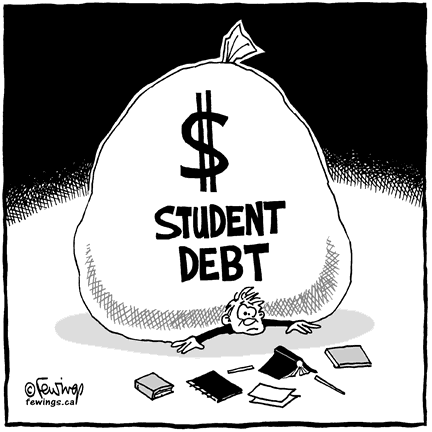
[Click here to check current credit card offers, including rates and terms.] When Angela Moore looks into her future, she sees checks for $500, $147, $280 and $250 piling up like leaves in a forest. Those are the amounts she could be paying every single month on her four student loans, which total $92,000, for the next several decades. If she postpones payments, the amounts she owes will go up. If she skips them, she could ruin her credit and end up in court.
Moore, 26, graduated with a bachelor's degree from the University of Hartford in 2009 with $25,000 in federal student loans and $67,000 in private loans. She devotes about half of her paycheck to those bills and resorts to credit cards to cover other expenses. Says Moore, the first in her family to graduate from college, "It's heartbreaking to have a college degree and not be able to pay for normal things because I have to pay student loans."
Moore works at an orthopedic surgeon's office, the same job she had in college. She would like to move on someday but can't afford to make less than her current wage of about $18 an hour. Nor does she see an obvious way out of her predicament. "If you're in that much debt and have a house or car, you at least have something you can give back. I have a piece of paper. I have nothing to give back."
Meet the young and burdened. Of borrowers who graduated from four-year colleges in 2008, 10% walked away with $40,000 or more in student debt, almost three times the number of students who borrowed at that level in 2000, according to the Project on Student Debt, an advocacy group. The default rate for students who entered repayment between fiscal year 2006 and fiscal year 2007 was 6.7%, the highest since 1998.
You'd think bankruptcy would be a solution to massive student debt, but for most people, it is not an option. You must demonstrate to a judge that repayment would cause "undue hardship," a term interpreted by some courts to mean the "certainty of hopelessness," according to Deanne Loonin, of the National Consumer Law Center. This strict standard applies to both federal and private student loans. Proposed legislation in Congress would change that standard for private student loans, making them eligible for discharge under the more lenient rules that apply to credit-card and other consumer debt.
Meanwhile, federal loans offer programs that let you reduce payments or even qualify for loan forgiveness. As for private loans, some lenders are offering deals to borrowers rather than see loans go south.
Cut a Deal With a Lender
A few years ago, lenders were rushing to offer private loans to students, including those who were less than creditworthy. Now, borrowers who couldn't afford the loans in the first place are defaulting in droves, says Joshua Cohen, a Hartford-based lawyer who specializes in debt. "The industry is either going to take a bath or start coming after people."
Some lenders hope to avoid both scenarios by offering interest-only repayments or other arrangements that lower payments for a time. "It does us no good to have a customer with a loan he or she is unable to repay," says Patricia Christel, of Sallie Mae, the giant student-loan company. Check your promissory note to see whether it includes such provisions. "It's very case-by-case," says Loonin. If it does not, try to negotiate a plan with your lender.
If you don't reach an agreement, ask the lender for forbearance, in which you make no payments at all for three-month increments, usually for no more than a year (interest continues to accrue). Lenders are less willing than they once were to sign off on these deals, but they may do so if they believe the break will get you back on track. "The important message is, contact your lender sooner rather than later," says Tim Ranzetta, of Student Lending Analytics.
With federal loans, you can be past due for months before going into default. With private loans, you generally fall into that category as soon as you miss one payment. A collector will start calling, and eventually a third-party collection agency will take over the loan. (The Fair Debt Collection Practices Act protects you from abusive collection practices.
Unlike the feds, who have the authority to tap your resources, private creditors must go to court to collect debts. "Until then, there's nothing they can do," says Cohen. Defaults are subject to your state's statute of limitations, typically six years. If you do get sued and lose, the creditor can garnish your wages, put a lien on your house and wipe out your bank account.
Pick a Plan From Uncle Sam
Federal loans, which include Perkins loans, Stafford loans and Grad Plus loans, provide more options. (The Perkins loan repayment provisions differ somewhat from the other two; call your school for details.) For Staffords and Grad Plus loans, the standard plan gets you out from under after 120 equal monthly payments over ten years. If you can't afford those payments but expect to have a higher income in a few years, you can choose the graduated plan, through which you make lower payments in the first few years and higher payments later over the ten-year span. Because you pay less at the beginning, you pay more interest overall.
If you owe at least $30,000 in federal loans, consider the extended repayment plan, which lets you stretch monthly payments as far out as 25 years, for lower monthly amounts but at a higher cost. Or you can consolidate your federal loans through the federal Direct Loan program and extend your payments to 12 to 30 years, depending on the amount you owe. (For details, seewww.loanconsolidation.ed.gov.)
Borrowers whose federal debt outstrips their annual income should look into the income-based repayment plan, which is "like gold" for those who qualify, says Edie Irons, of the Project on Student Debt. This program, which improves on two other income-based programs, can reduce your payments to as low as zero.
You probably qualify if your total debt exceeds your annual income. After 25 years, any remaining debt is forgiven; you owe tax on the forgiven amount. If you enter the income-based repayment plan and then get a big bump in salary, your payments from that point on are calculated according to the standard plan.
Cops, public defenders, public-school teachers and others working full-time in the public sector qualify for cancellation of any remaining debt after 120 payments, made on or after October 1, 2007. To get this deal, your loans must be with the federal Direct Loan program, as opposed to the now-defunct program (known as FFEL) offered by private lenders. You can consolidate FFEL loans into the Direct Loan program. The forgiven amount is tax-free.
You have the right to defer federal-loan repayments for up to three years if you are unemployed, experiencing economic hardship, attending school at least half-time or serving on active duty in the military. The feds pick up the interest during the deferment on subsidized loans but not on unsubsidized loans. Call your lender for details.
If deferment isn't an option, ask your lender for forbearance. With a federal loan, you can suspend payments for up to three 12-month periods. Depending on the amount you earn and owe, you may be legally entitled to this deal. If not, ask anyway: It's in the lender's best interest to give you time to get on your feet. Interest accrues during forbearance.

Thursday, September 27, 2012

Paying for college with fertility clinics, sugar daddies

Everyone is recognizing the high costs of college tuition today, and many are turning to creative ways to pay off their debt. Check out this article from CNNMoney

By Blake Ellis | CNNMoney.com – Tue, Sep 18, 2012 5:11 AM EDT

What do sugar daddies, medical studies and pawnshops have in common? They help some students afford a college education.
With the average family reporting that they are only on track to meet 30% of their college savings goals, every extra dollar counts -- and nothing is off limits.
John McKinley-Campbell had no job, $135,000 in student loan debt and he wanted to go back to school to get his Ph.D. at Florida International University. In order to afford to make it all happen he became a lab rat.
He has been participating in medical studies for pharmaceutical companies ever since his aunt saw an advertisement for one on TV. He lived in a medical facility for 14 days to test an arthritis medication and then signed up to receive injections of a breast cancer drug through an IV over the course of 8 days.
Those two studies alone will earn him about $8,500, which he plans to put toward an $1,800 GRE preparation course, the GRE test fee of $175 and the university's $100 application fee. The rest will go toward housing and tuition if he gets accepted. "If I can't find work [while in school], there's always a headache medicine I could test," he said.
Norah, who asked that her last name not be included for privacy reasons, has taken a slightly different route. She decided to become an egg donor at Shady Grove Fertility Center in Maryland this year, one of the largest fertility centers in the country.
The 24-year-old grad student earned $6,500 for her first egg donation, which almost covers her entire first year of school. A couple more egg donations will leave her with enough money to pay the full cost of the program -- around $15,000.
"When I worked a second job [between college and graduate school], it took me almost a year working in retail to make this same amount I've already made from one egg donation," she said.
Along those lines, a sperm donor at California Cryobank, who requested to remain anonymous, said he has earned $2,600 from making sperm donations for the past year, helping him cover his college living expenses and lab fees.
California Cryobank, which has several locations around the country, said nearly half of its qualified donors are college students, and sperm donors can make up to $1,200 per month -- or $14,400 a year -- if they donate three times a week.
Other cash-strapped college students are using their looks and sex appeal to find "sugar daddies" who are willing to foot their tuition bills.
One 21-year-old student said she receives a monthly allowance from a 37-year-old "sugar daddy" she met through online dating site SeekingArrangement.com, which helps rich men find young women who are looking to be supported financially. In exchange for her company, she says her sugar daddy has been making her full tuition payments of $1,500 each month.
According to SeekingArrangement, that allowance is low compared to what most college students on the site receive. About 41%, or 350,000, of the sugar babies on SeekingArrangement.com are college students, and two-thirds of them say they are using their sugar daddy as a primary or secondary means of paying for college -- receiving an average of $4,200 a month for college expenses, according to the company.
Parents are also finding creative ways to cover their kids' college costs.
After coming up $4,000 short for his son's tuition, Dave McDougall, pawned 15 pens from his $40,000 collection of luxury and vintage pens as collateral for a $4,100 pawnshop loan. The loan came with a steep 6% monthly interest rate -- amounting to a 72% annualized rate (personal loans often come with annualized interest rates in the low teens). He plans on paying it off in September when he gets his bonus check from work.
Another parent, Carol Carlisle, hosts international students who come to the United States to learn English as a Second Language at a program called Intrax in San Francisco, which pays host families about $32 a night. She's using that money to pay back the home equity loan she and her husband took out to pay for their daughter's college tuition.
Carlisle began hosting students in June and has already made about $2,700 -- $1,800 of which she put toward the loan. She expects to be able to completely pay off the loan after hosting students for a few years.
"When our daughter graduated high school in 2005, we thought we would use our home equity to pay for college and would pay it back, but then 2008 came around and my husband is a builder and everything collapsed for him," said Carlisle. "Besides being a joy [to host ESL students], we get this check every month, and we can finally make payments on that home equity."
And if you thought it couldn't get any more unconventional, Wayne Perry has started saving early for his son's education by making money off of a YouTube video that unexpectedly went viral, featuring his newborn son holding the forceps used to cut his own umbilical cord. With more than one million views, Perry said he is raking in around $1,000 a month from Google AdSense, which places ads on YouTube videos and other online content and pays the publisher based on how often the ads are clicked on or viewed.
He says he's putting that money -- $8,000 so far -- into a college fund for his son, who is now two years old. If the payments continue, he thinks he could easily have more than $100,000 saved by the time his son is 18.
"We're middle class, where we make too much to get a lot of [college] grants and low-cost loans but don't make enough to foot the bill for a really great school -- and imagine when he's 18 what the cost of tuition will be," said Perry. "I could never have saved that kind of money for him without this -- never."

Sunday, June 10, 2012

Be Money Smart in College

J.D Roth, the author of getrichslowly.com, wrote this article for college students looking to make money and get rich. Enjoy.


School’s back in session, and with it come life-lessons in money management for students. But personal finance can be easy, even if you’re just starting out. You just have to know how it works. All of the following are concepts I wish I had known before heading to college.
Money Management
Now that you’re on your own, you might be tempted to spend money on all the things your parents wouldn’t let you have before. Go slow. If you play it smart, you can avoid the sort of money troubles that plague many young adults.
  • Join a credit union. Don’t just sign up for a random bank giving away t-shirts or frisbees at registration. Track down a credit union in town, or do some research into online banks.
  • Don’t get a credit card unless you absolutely need one. Don’t be a sucker. Those guys sitting behind the sign-up table are not there to help you. They’re there to make money.
  • Avoid non-academic debt. It might seem like a good idea to put that Xbox on a credit card, but it’s not. Focus on developing good money skills with cash. Worry about credit later.
  • Save and then splurge. If you decide you must have that Xbox, then save for it. Wait until you can pay cash.
  • Pay your bills on time. Basic advice, but it’s surprising how many people lose track of things. If you pay your bills as they arrive, you won’t have to worry about forgetting them.
Organization and Planning
Some minimal organization will keep your finances in order. Each of these is an important adult financial skill.
  • Track your spending. Use a notebook, or use Quicken if you have it. Good records will prevent you from getting overdrawn at the bank or charging more than your credit limit. This habit also allows you to detect spending patterns.
  • Make a budget. It doesn’t have to be fancy. At the start of the month, estimate how much money you’ll receive and decide where needs to go. Remember: you don’t need to spend it all.
  • Save your receipts. Put them in a shoebox under your bed if you must, but hold onto them. You’ll need to be able to compare them with statements at the end of the month. And some you’ll need to keep for several years.
  • Guard your vital stats. Don’t give out your social security number or your credit card info except to known and trusted sources.
Campus Life
It seems like there are a hundred thing competing for your money. It’s hard to know what to do. Here are some smart ways to save money on campus.
  • Buy used textbooks. You’re just going to sell them back at the end of the term. (Or end up wishing you had done so five years from now.) You don’t need new textbooks.
  • Skip spring break. Forget the long road trips. You can have a lot of fun for cheap close to campus. (My college used to organize economical group trips; yours probably does, too.) You might be surprised at how fun it can be to stay on campus, too.
  • Live without a car. Cars are expensive: gas, maintenance, insurance, registration, parking. Stick close to campus. Learn to use mass transit. Find a friend who has a car.
  • Don’t hang out with big spenders. Some kids have parents with deep pockets. Other kids are well down the road to financial trouble. Hanging out with them can lead you to spend more than you can afford.
  • Take advantage of campus activities. There’s always something to do. Attend free movie festivals. Pay a few bucks to see the local symphony every month. Support the sports teams. Attend lecture series. Get the most from your student ID!
Personal Life
Take care of yourself. Your mother isn’t around to remind you to brush your teeth. Nobody’s going to scold you for eating three bowls of Cap’n Crunch. Self-discipline is more important now than it ever has been in your life.
  • Go to class. You’re in college to learn. Everyone skips now and then, but don’t make it a habit. What you learn and do now will have a profound impact on the rest of your life.
  • Get involved. Staying busy staves off boredom. It also helps you build skills and form social networks that will last a lifetime. Try out for a play. Join the astronomy club. Write for the school paper. Find something that sounds fun to you and do it. Take risks!
  • Stay active. A healthy body costs far less to maintain than an unhealthy body. You don’t have to do much to avoid gaining weight in college. A walk around campus each day will probably do it.
  • Eat healthy. It’s possible to eat well on a small budget if you know what you’re doing.
  • Limit vices. Beer, cigarettes, and pot are expensive. They also screw with your body and mind. Take it easy on the vices. There’s nothing wrong with a drink or two on Friday night, but don’t go overboard.
  • Learn the art of the Cheap Date. The student’s guide to cheap dates suggests:
    • Take advantage of mother nature
    • Go for coffee
    • Use CitySearch to track down cheap food and activities
    • Attend campus events
  • Have fun. Your college years will be some of the best of your life. It’s trite, but true. Make the most of them.
Decision Making
Get in the habit of making smart choices now, and you’ll develop a pattern of behavior that will stand you in good stead the rest of your life.
  • Make smart choices. You can do anything you want, but you can’t do everything you want. Decide what’s important to you, and pursue that. And remember to leave time for yourself.
  • When you want to buy something, ask yourself “Do I need it?” If you think you do, then wait. Don’t buy on impulse. Write the object of your desire on a piece of paper and pin it to the wall. Look at it every day for a week. If, at the end of the week, you still think you need it, then consider purchasing it.
Making Money
I’ve saved the best for last. If you can master even one of these, you’ll have a head-start on your friends. Master all four, and you’ll be on the road to wealth. No kidding.
  • Spend less than you earn. Don’t earn much? Then don’t spend much. If your spending and income are roughly even, you have two choices: earn more or spend less. When I was in college, I worked as many as four jobs at once. This gave me a lot of spending cash. (Unfortunately, I didn’t do a good job with the spend less part of the equation.)
  • Be an outstanding employee. Good work habits can pay enormous dividends, leading to recommendations and contacts that you can use after you’re out of school. Several of my classmates turned work-study jobs into launching pads for future careers.
  • Start your own business. Can you install a hard drive? Can you strip a computer of spyware? Can you perform minor car repairs? Do you have a pickup truck you could use to haul furniture? Are you a passable guitar player? Charge cheap rates and exceed expectations. Word will spread. When you’ve built up a customer base, you can raise your rates a little. This is an awesome way to make money.
  • Learn to invest. Find a discount broker and begin making regular investments. Sharebuilder is a great choice for college students. It costs only $4 to make a scheduled stock purchase, and you can invest any amount of money, even $20. Don’t obsess over the details yet. You can worry about high returns and low fees later. Right now the most important thing is to develop the investment habit. (Ad: Buy Stocks for $4 at ShareBuilder.) Ten years from now,you’ll thank yourself. If you can find a way to invest $1000 a year for the next ten years, you can set yourself up for life. No joke.

Saturday, August 27, 2011

Make Money Selling your Photos


Just some of the types of stock photos for sale online.


There are so many kids in high school and college who pick up photography as a hobby, but few know that their hobby can actually become a lucrative way to make money. In this post I will give you a quick guide on how to make money by using stock photography websites.

What are stock photos?
Students can use Google to find images when they need pictures for a report, but because of copy write laws, businesses must buy their photos (these are stock photos). Stock photos are used by companies, artists, agencies, and corporations whenever they need an image for something.

What are stock photography websites?
Stock photography websites serve as marketplaces for people to buy and sell stock photos online. These sites take images from individual contributors, and the photographers get a commission for each image sold.

How do I make money from these websites?
To make money, simply make accounts and post your photos on these websites. Your photos can be of literally anything, so pull up your pictures from your high school photography class and let the money roll in. Many websites do not sell the exclusive rights to your photos either, meaning that you can list your photos on multiple sites to increase your earnings.

Here is a list of 33 stock photography websites you can post your photos on. Good luck, and with enough stock photos for sale in enough places, you could be making a significant amount of extra money.

Sunday, July 17, 2011

Apply for Scholarships

It can pay to be a student.
As a college student, you have the unique opportunity of receiving scholarship money; all you have to do is apply for it. I strongly recommend this to you, especially if you are a hard working student and you can write a decent essay.

How to apply for scholarships
The first thing you need to do is make accounts on scholarships.com and fastweb.com. These websites suggest scholarships for you to apply for depending on your unique profile. After that, simply search for scholarships and apply for them. Most scholarships require you to write an essay. This is the only potentially time consuming part of applying, but taking your essays to your university’s writing center can both decrease the time you spend on them and increase the quality of your essays.

Also make sure to keep your eyes open for scholarships that your college offers. Many students do not know about them, or do not bother to apply, and their mistake can turn into your profit.

Do not be discouraged if your first five, ten or even twenty applications are denied. It only takes one $1000 or $2000 scholarship to make it all worth it. Persistence is key!