Showing posts with label job. Show all posts

Saturday, November 24, 2012

How to Conquer your Student Loans


Don't despair. You have options with private lenders and the feds to cut your payments.
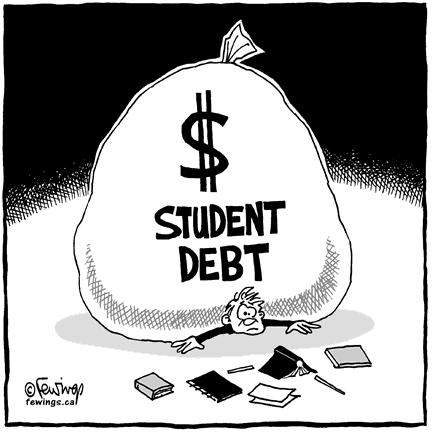
[Click here to check current credit card offers, including rates and terms.] When Angela Moore looks into her future, she sees checks for $500, $147, $280 and $250 piling up like leaves in a forest. Those are the amounts she could be paying every single month on her four student loans, which total $92,000, for the next several decades. If she postpones payments, the amounts she owes will go up. If she skips them, she could ruin her credit and end up in court.
Moore, 26, graduated with a bachelor's degree from the University of Hartford in 2009 with $25,000 in federal student loans and $67,000 in private loans. She devotes about half of her paycheck to those bills and resorts to credit cards to cover other expenses. Says Moore, the first in her family to graduate from college, "It's heartbreaking to have a college degree and not be able to pay for normal things because I have to pay student loans."
Moore works at an orthopedic surgeon's office, the same job she had in college. She would like to move on someday but can't afford to make less than her current wage of about $18 an hour. Nor does she see an obvious way out of her predicament. "If you're in that much debt and have a house or car, you at least have something you can give back. I have a piece of paper. I have nothing to give back."
Meet the young and burdened. Of borrowers who graduated from four-year colleges in 2008, 10% walked away with $40,000 or more in student debt, almost three times the number of students who borrowed at that level in 2000, according to the Project on Student Debt, an advocacy group. The default rate for students who entered repayment between fiscal year 2006 and fiscal year 2007 was 6.7%, the highest since 1998.
You'd think bankruptcy would be a solution to massive student debt, but for most people, it is not an option. You must demonstrate to a judge that repayment would cause "undue hardship," a term interpreted by some courts to mean the "certainty of hopelessness," according to Deanne Loonin, of the National Consumer Law Center. This strict standard applies to both federal and private student loans. Proposed legislation in Congress would change that standard for private student loans, making them eligible for discharge under the more lenient rules that apply to credit-card and other consumer debt.
Meanwhile, federal loans offer programs that let you reduce payments or even qualify for loan forgiveness. As for private loans, some lenders are offering deals to borrowers rather than see loans go south.
Cut a Deal With a Lender
A few years ago, lenders were rushing to offer private loans to students, including those who were less than creditworthy. Now, borrowers who couldn't afford the loans in the first place are defaulting in droves, says Joshua Cohen, a Hartford-based lawyer who specializes in debt. "The industry is either going to take a bath or start coming after people."
Some lenders hope to avoid both scenarios by offering interest-only repayments or other arrangements that lower payments for a time. "It does us no good to have a customer with a loan he or she is unable to repay," says Patricia Christel, of Sallie Mae, the giant student-loan company. Check your promissory note to see whether it includes such provisions. "It's very case-by-case," says Loonin. If it does not, try to negotiate a plan with your lender.
If you don't reach an agreement, ask the lender for forbearance, in which you make no payments at all for three-month increments, usually for no more than a year (interest continues to accrue). Lenders are less willing than they once were to sign off on these deals, but they may do so if they believe the break will get you back on track. "The important message is, contact your lender sooner rather than later," says Tim Ranzetta, of Student Lending Analytics.
With federal loans, you can be past due for months before going into default. With private loans, you generally fall into that category as soon as you miss one payment. A collector will start calling, and eventually a third-party collection agency will take over the loan. (The Fair Debt Collection Practices Act protects you from abusive collection practices.
Unlike the feds, who have the authority to tap your resources, private creditors must go to court to collect debts. "Until then, there's nothing they can do," says Cohen. Defaults are subject to your state's statute of limitations, typically six years. If you do get sued and lose, the creditor can garnish your wages, put a lien on your house and wipe out your bank account.
Pick a Plan From Uncle Sam
Federal loans, which include Perkins loans, Stafford loans and Grad Plus loans, provide more options. (The Perkins loan repayment provisions differ somewhat from the other two; call your school for details.) For Staffords and Grad Plus loans, the standard plan gets you out from under after 120 equal monthly payments over ten years. If you can't afford those payments but expect to have a higher income in a few years, you can choose the graduated plan, through which you make lower payments in the first few years and higher payments later over the ten-year span. Because you pay less at the beginning, you pay more interest overall.
If you owe at least $30,000 in federal loans, consider the extended repayment plan, which lets you stretch monthly payments as far out as 25 years, for lower monthly amounts but at a higher cost. Or you can consolidate your federal loans through the federal Direct Loan program and extend your payments to 12 to 30 years, depending on the amount you owe. (For details, seewww.loanconsolidation.ed.gov.)
Borrowers whose federal debt outstrips their annual income should look into the income-based repayment plan, which is "like gold" for those who qualify, says Edie Irons, of the Project on Student Debt. This program, which improves on two other income-based programs, can reduce your payments to as low as zero.
You probably qualify if your total debt exceeds your annual income. After 25 years, any remaining debt is forgiven; you owe tax on the forgiven amount. If you enter the income-based repayment plan and then get a big bump in salary, your payments from that point on are calculated according to the standard plan.
Cops, public defenders, public-school teachers and others working full-time in the public sector qualify for cancellation of any remaining debt after 120 payments, made on or after October 1, 2007. To get this deal, your loans must be with the federal Direct Loan program, as opposed to the now-defunct program (known as FFEL) offered by private lenders. You can consolidate FFEL loans into the Direct Loan program. The forgiven amount is tax-free.
You have the right to defer federal-loan repayments for up to three years if you are unemployed, experiencing economic hardship, attending school at least half-time or serving on active duty in the military. The feds pick up the interest during the deferment on subsidized loans but not on unsubsidized loans. Call your lender for details.
If deferment isn't an option, ask your lender for forbearance. With a federal loan, you can suspend payments for up to three 12-month periods. Depending on the amount you earn and owe, you may be legally entitled to this deal. If not, ask anyway: It's in the lender's best interest to give you time to get on your feet. Interest accrues during forbearance.

Sunday, November 11, 2012

The Most Underrated Jobs 2012

These Jobs Get No Respect! But They Should...

These are the jobs that you usually don’t hear a mother proudly say, “My son is a ________!” or see Hollywood glamorizing one of these underrated jobs -- but when you look at the stats, they should be!

“You never saw a movie about a civil engineer or a TV show starring a computer-systems analyst!” said Tony Lee, publisher of CareerCast.com. 

The job listing and advice site has come out with its annual list of the most underrated jobs – and the most overrated jobs. 

So, what makes a job underrated? 

“The pay is better, the hiring outlook is better , the level of stress tends to be lower, and the physical demands aren’t that great,” Lee said. “It’s a good job with a good forecast.” 

He added: “The most underrated jobs offer increasing opportunities and rewarding potential for job seekers new to the labor force, or those who need a change.” What’s more, several of these positions don’t even require a college degree. 

Read ahead for the Most Underrated Jobs of 2012. 

1. Computer Systems Analyst
Median Salary: $78,148 

These are the guys who study an organization’s computer systems and procedures and make recommendations for how to better organize, manage, and upgrade technology. 

These guys aren’t usually the heroes in the movie – if they’re even in the movie – but if you’ve ever used a computer at your job you know this is one of the most necessary, and underrated, jobs. 

“It’s a terrific job,” Lee said. “Demand is extremely high. Pay is strong. And you get to work pretty autonomously.” 

According to the Bureau of Labor Statistics, this profession is expected to grow 22 percent in the next decade. 

Computer systems analysts, we salute you. Your job is underrated!

2. Civil Engineer
Median Salary: $78,133 

The only time civil engineers really get respect seems to be on the History Channel. And this area of engineering, which is on the lower end of the engineering pay scale, tends to not be that popular. 

But right now, Lee said, there is huge demand for rebuilding bridges, roads, and other infrastructure, all of which require civil engineers. 

“At long last, we seem to be moving forward with infrastructure improvement in the country,” Lee said, adding that there are actually shortages of engineers right now.


3. Veterinarian

Median Salary: $82,190 

“With the amount of work and school being so high, the perception is that, ‘If I’m going to do that, I should just be a person doctor!’” Lee said. 

In fact, there’s a real shortage of veterinarians, he said. Plus, you get to manage your own schedule, and you don’t have to worry about health-care regulations! 

What’s more, Lee said, Look at the baby boom generation: “They are at the wealthiest stage of their lives, and they all have pets!” 

Boom! Demand.

4. Biologist
Median Salary: $73,285 

When was the last time you heard a kid say, “I want to be a biologist when I grow up!” 

Right. Well, maybe they should. 

“There’s a lot of demand,” Lee said. “Biologists have a lot of things going for them. They’re needed by the whole military complex, with biological weapons. At the same time, they have mapped the human genome – so, there’s biological science in health care.” 

“The need for biologists is very large. And yet biology is a field that has not attracted huge numbers of new graduates,” Lee said.

5. Market Research Analyst

Median Salary: $61,236 

“This is one where we’ve become such an incredible consumer nation and market research has really elevated it to where there isn’t a product or service that doesn’t require market research,” Lee said. “And yet most people don’t think of market research as a profession. They might think of going into marketing but that’s different from market research.”


6. Accountant

Median Salary: $62,174 

Oh, accountants. When was a movie ever made that didn’t show them as nerdy and uninteresting? Well, accountants, you can stick this in your pocket protector – you are among the most underrated jobs! 

“In fact, it’s a very solid, secure profession,” Lee said. “Accountants are needed whether the economy is good or bad.” 

And, let’s face it, the most recent downturn and subsequent scrutiny on accounting highlighted the need for accountants even more.


See the full list: The Most Underrated Jobs

Saturday, November 10, 2012

The Most Overrated Jobs 2012


They May Seem Dreamy, but...
It may seem glamorous to be a slick advertising executive like Jon Hamm on the TV show “Mad Men” or like Michael Douglas’s power broker character in the movie “Wall Street.” 

But times change and the professions that seemed alluring in the 1980s may not be so glamorous now.

Job listing and advice site CareerCast.com has come out with its annual list of the most overrated jobs – and the most underrated jobs. 

We’ve all been to a restaurant we’d deem “overrated,” or met that guy in the office we’d call overrated. So what makes a job overrated?

“Poor outlook for future growth, long hours, stress, and a multitude of new candidates entering the industry make it especially challenging to break into many of our overrated careers,” said Tony Lee, publisher of CareerCast.com. “We find jobs that are perceived as being really great for one reason or another and kind of show -- they’re not as great as you think.” 

So, the next time you encounter a woman who boasts, “Well, my son is a ______,” maybe you say, “Hmmm. Not so much.” 

Read ahead for some of the Most Overrated Jobs of 2012. 

Advertising Agency Executive
Median Salary: $64,107 

Oh, Jon Hamm makes it look so easy and so glamorous on the hit show “Mad Men,” but the truth is, advertising is a very stressful, high-turnover business, Lee said. It’s not all about how you hold a glass of Scotch or woo a beautiful woman. 

“You might perceive it to be a really cool job, but in fact, it’s overrated,” Lee said.


Senior Corporate Executive
Median Salary: $166,141 

“Most people think of it as flying on a corporate jet and a nice dining room every day,” Lee said. “The real issue with executives is that you’re responsible for the careers and lives of everyone who works for the company. Any wrong decision is on your head. And if the company is publicly-traded, you’re responsible to shareholders.” 

There has always been stress to perform and meet budgets, but never is that stress higher on executives than during a recession. 

“Any time you have an economic downturn, it puts the squeeze on more senior level executives who have to manage revenue against a poorer environment and it’s hard,” Lee said.


Commercial Airline Pilot
Median Salary: $103,158 

Sure, it may seem like soaring through the clouds and traveling the globe, but the airline industry has been devastated by cost-cutting efforts, which means on top of passenger safety, terrorism, and bad weather, many pilots now face lower salaries and budget pressures. 

“Maybe they’re sitting on a tarmac too long and burning fuel, or the weather forces them to go out of their way and all of that is going to cost more – they now have many more concerns than just safely flying a plane,” Lee said.

Architect
Median Salary: $73,179

This hybrid left brain/right brain career may seem appealing and the perception is that you get to play with models all day. In fact, it’s always been grueling work, full of long hours, but it took a huge hit when the housing bubble burst — many architects had to go out of business because there isn’t enough demand for their services.

But the housing market is starting to turn, finally, so stay tuned for next year – maybe it will change teams and be on the underrated list!
Surgeon
Median Salary: $305,078 

So the next time a woman brags, “My son is a doctor!” you can smile knowing it’s not all that. 

It’s not just the pure joy and mastery of surgery. For sure, surgery has always been stressful – it’s long hours on your feet, patients’ lives are in your hands, and you’re on call 24/7. 

“Your life’s really not your own,” Lee said. “And now, with health-care regulation and insurance requirements, many surgeons spend most of their time handling administrative stuff,” he said. 

And don’t even get the nursing staff started on the God Complex! 

Sorry, surgeons, you’re overrated.

Attorney
Median Salary: $112,760 

“The perception is that just be a lawyer and you’ll be in great shape,” Lee said. In fact, the legal profession took a huge hit from the recession. Turnover is high and the work is grueling. It’s not all golf and coming down hard in court with an Oscar-worthy “You can’t handle the truth!” 

“You don’t expect when you’re in law school that you’ll be spending 70 to 80 hours a week reading contracts!” Lee said.

See the full list : The Most Overrated Jobs 2012

Thursday, October 4, 2012

College is not for Everyone

A person who compares the annual earnings of college and high school graduates would no doubt conclude that higher education is a good investment—the present value of the college earnings premium (the better part of $1 million) seemingly far outdistances college costs, yielding a high rate of return. But for many, attending college is unequivocally not the right decision on purely economic grounds.

First of all, college graduates on average are smarter and have better work habits than high school graduates. Those who graduated from college were better students in high school, for example. Thus, at least a portion of the earnings premium associated with college has nothing to do with college per se, but rather with other traits.

Second, a goodly proportion (more than 40 percent) of those attending four-year colleges full-time fail to graduate, even within six years. At some colleges, the dropout rate is strikingly higher. While college students sometimes still gain marketable skills from partial attendance, others end up taking jobs that are often given to high school graduates, making little more money but having college debts and some lost earnings accrued while unsuccessfully pursing a degree.

Third, not everyone is average. A non-swimmer trying to cross a stream that on average is three feet deep might drown because part of the stream is seven feet in depth. The same kind of thing sometimes happens to college graduates too entranced by statistics on averages. Earnings vary considerably between the graduates of different schools, and within schools, earnings differ a great deal between majors. Accounting, computer science, and engineering majors, for example, almost always make more than those majoring in education, social work, or ethnic studies.

Fourth, the number of new college graduates far exceeds the growth in the number of technical, managerial, and professional jobs where graduates traditionally have gravitated. As a consequence, we have a new phenomenon: underemployed college graduates doing jobs historically performed by those with much less education. We have, for example, more than 100,000 janitors with college degrees, and 16,000 degree-holding parking lot attendants.

Does this mean no one should go to college? Of course not. First of all, college is more than training for a career, and many might benefit from the social and non-purely academic aspects of advanced schooling, even if the rate of return on college as a financial investment is low. Second, high school students with certain attributes are far less likely to drop out of school, and are likely to equal or excel the average statistics.

Students who do well in high school and on college entrance exams are much more likely to graduate. Those going to private schools may pay more in tuition, but they also have lower dropout rates. Those majoring in some subjects, such as education or one of the humanities, can sometimes improve their job situation by double majoring or earning a minor in, say, economics.

As a general rule, I would say graduates in the top quarter of their class at a high-quality high school should go on to a four-year degree program, while those in the bottom quarter of their class at a high school with a mediocre educational reputation should not (opting instead for alternative methods of credentialing and training).

Original Post: http://www.businessweek.com/articles/2012-04-09/why-college-isnt-for-everyone?cmpid=yhoo


Thursday, September 27, 2012

Paying for college with fertility clinics, sugar daddies

Everyone is recognizing the high costs of college tuition today, and many are turning to creative ways to pay off their debt. Check out this article from CNNMoney

By Blake Ellis | CNNMoney.com – Tue, Sep 18, 2012 5:11 AM EDT

What do sugar daddies, medical studies and pawnshops have in common? They help some students afford a college education.
With the average family reporting that they are only on track to meet 30% of their college savings goals, every extra dollar counts -- and nothing is off limits.
John McKinley-Campbell had no job, $135,000 in student loan debt and he wanted to go back to school to get his Ph.D. at Florida International University. In order to afford to make it all happen he became a lab rat.
He has been participating in medical studies for pharmaceutical companies ever since his aunt saw an advertisement for one on TV. He lived in a medical facility for 14 days to test an arthritis medication and then signed up to receive injections of a breast cancer drug through an IV over the course of 8 days.
Those two studies alone will earn him about $8,500, which he plans to put toward an $1,800 GRE preparation course, the GRE test fee of $175 and the university's $100 application fee. The rest will go toward housing and tuition if he gets accepted. "If I can't find work [while in school], there's always a headache medicine I could test," he said.
Norah, who asked that her last name not be included for privacy reasons, has taken a slightly different route. She decided to become an egg donor at Shady Grove Fertility Center in Maryland this year, one of the largest fertility centers in the country.
The 24-year-old grad student earned $6,500 for her first egg donation, which almost covers her entire first year of school. A couple more egg donations will leave her with enough money to pay the full cost of the program -- around $15,000.
"When I worked a second job [between college and graduate school], it took me almost a year working in retail to make this same amount I've already made from one egg donation," she said.
Along those lines, a sperm donor at California Cryobank, who requested to remain anonymous, said he has earned $2,600 from making sperm donations for the past year, helping him cover his college living expenses and lab fees.
California Cryobank, which has several locations around the country, said nearly half of its qualified donors are college students, and sperm donors can make up to $1,200 per month -- or $14,400 a year -- if they donate three times a week.
Other cash-strapped college students are using their looks and sex appeal to find "sugar daddies" who are willing to foot their tuition bills.
One 21-year-old student said she receives a monthly allowance from a 37-year-old "sugar daddy" she met through online dating site SeekingArrangement.com, which helps rich men find young women who are looking to be supported financially. In exchange for her company, she says her sugar daddy has been making her full tuition payments of $1,500 each month.
According to SeekingArrangement, that allowance is low compared to what most college students on the site receive. About 41%, or 350,000, of the sugar babies on SeekingArrangement.com are college students, and two-thirds of them say they are using their sugar daddy as a primary or secondary means of paying for college -- receiving an average of $4,200 a month for college expenses, according to the company.
Parents are also finding creative ways to cover their kids' college costs.
After coming up $4,000 short for his son's tuition, Dave McDougall, pawned 15 pens from his $40,000 collection of luxury and vintage pens as collateral for a $4,100 pawnshop loan. The loan came with a steep 6% monthly interest rate -- amounting to a 72% annualized rate (personal loans often come with annualized interest rates in the low teens). He plans on paying it off in September when he gets his bonus check from work.
Another parent, Carol Carlisle, hosts international students who come to the United States to learn English as a Second Language at a program called Intrax in San Francisco, which pays host families about $32 a night. She's using that money to pay back the home equity loan she and her husband took out to pay for their daughter's college tuition.
Carlisle began hosting students in June and has already made about $2,700 -- $1,800 of which she put toward the loan. She expects to be able to completely pay off the loan after hosting students for a few years.
"When our daughter graduated high school in 2005, we thought we would use our home equity to pay for college and would pay it back, but then 2008 came around and my husband is a builder and everything collapsed for him," said Carlisle. "Besides being a joy [to host ESL students], we get this check every month, and we can finally make payments on that home equity."
And if you thought it couldn't get any more unconventional, Wayne Perry has started saving early for his son's education by making money off of a YouTube video that unexpectedly went viral, featuring his newborn son holding the forceps used to cut his own umbilical cord. With more than one million views, Perry said he is raking in around $1,000 a month from Google AdSense, which places ads on YouTube videos and other online content and pays the publisher based on how often the ads are clicked on or viewed.
He says he's putting that money -- $8,000 so far -- into a college fund for his son, who is now two years old. If the payments continue, he thinks he could easily have more than $100,000 saved by the time his son is 18.
"We're middle class, where we make too much to get a lot of [college] grants and low-cost loans but don't make enough to foot the bill for a really great school -- and imagine when he's 18 what the cost of tuition will be," said Perry. "I could never have saved that kind of money for him without this -- never."

The 11 Worst-Performing Cities in America

When you graduate, you will (hopefully) have the option to move to a new city and take on an exciting job. Just make sure to consider the local economies in the areas you might move to... and avoid these cities at all costs.

While the U.S. recovery creeps forward, some cities are getting left behind.

We identified the weakest economic recoveries based on the latest MetroMonitor from the Brookings Institute, which looks at employment, unemployment, production, and home prices. They're located in places like upstate New York, where the initial housing crash was less dramatic, but the slowdown more prolonged.

Flickr/Shannon Frost#1 Little Rock, Arkansas

-- Unemployment rate down 0.7 percentage points since 2011Q3
-- Employment up 0.7% since 2010Q1
-- Gross metro product up 2.9% since 2010Q1
-- Home prices at a new low in 2012Q1


Flickr Creative Commons/Nicholas_T#2 Harrisburg, Pennsylvania

-- Unemployment rate down 0.9 percentage points since 2010Q1
-- Employment down 1.2% since 2010Q1
-- Gross metro product up 1.5% since 2009Q3
-- Home prices at a new low in 2012Q1


Wikipedia#3 Virginia Beach, Virginia

-- Unemployment down 1.1 percentage points since 2010Q1
-- Employment up 1.5% since 2010Q1
-- Gross metro product up 1.0% since 2012Q1
-- Home prices at a new low in 2012Q1


Wikimedia Commons#4 Albany, New York

-- Unemployment hit a new high in 2012Q2
-- Employment up 1.7% since 2011Q1
-- Gross metro product up 5.0% since 2009Q3
-- Home prices at a new low in 2012Q1


Flickr/dougtone#5 Buffalo, New York
-- Unemployment hit a new high in 2012Q2
-- Employment up 1.8% since 2009Q4
-- Gross metro product up 5.1% since 2009Q2
-- Home prices at a new low in 2012Q


Flickr/MikeSheridan89#6 Philadelphia, Pennsylvania

-- Unemployment rate down 0.7 percentage points since 2010Q1
-- Employment up 1.4% since 2010Q1
-- Gross metro product up 3.4% since 2009Q3
-- Home prices at a new low in 2012Q1


Flickr/shchukin#7 Honolulu, Hawaii

-- Unemployment rate down 0.2 percentage points since 2009Q4
-- Employment up 2.5% since 2009Q4
-- Gross metro product up 3.6% since 2009Q3
-- Home prices at a new low in 2012Q1


#8 Jackson, Mississippi

-- Unemployment rate is down 1.3 percentage points since 2010Q1
-- Employment up 1.8% since 2010Q1
-- Gross metro product up 1.0% since 2009Q3
-- Home prices at a new low in 2012Q1


AP#9 Syracuse, New York

-- Unemployment hit a new high in 2012Q2
-- Employment up 1.8% since 2010Q1
-- Gross metro product up 6.5% since 2009Q2
-- Home prices at a new low in 2012Q1


#10 Poughkeepsie, New York

-- Unemployment hit a new high in 2012Q2
-- Employment up 2.2% since 2009Q3
-- Gross metro product up 6.1% since 2009Q2
-- Home prices at a new low in 2012Q1


Wikimedia Commons#11 Albuquerque, New Mexico

-- Unemployment down 1.4 percentage points since 2010Q3
-- Employment at a new low in 2012Q2
-- Gross metro product up 5.0% since 2008Q2
-- Home prices at a new low in 2012Q1


Data provided by the Brookings' MetroMonitor. Gross Metro Product and Home Prices are tracked from Trough to 2012Q2. Unemployment and Employment are tracked from Trough to 2012Q1.
Original post: http://finance.yahoo.com/news/the-11-worst-performing-cities-in-america.html